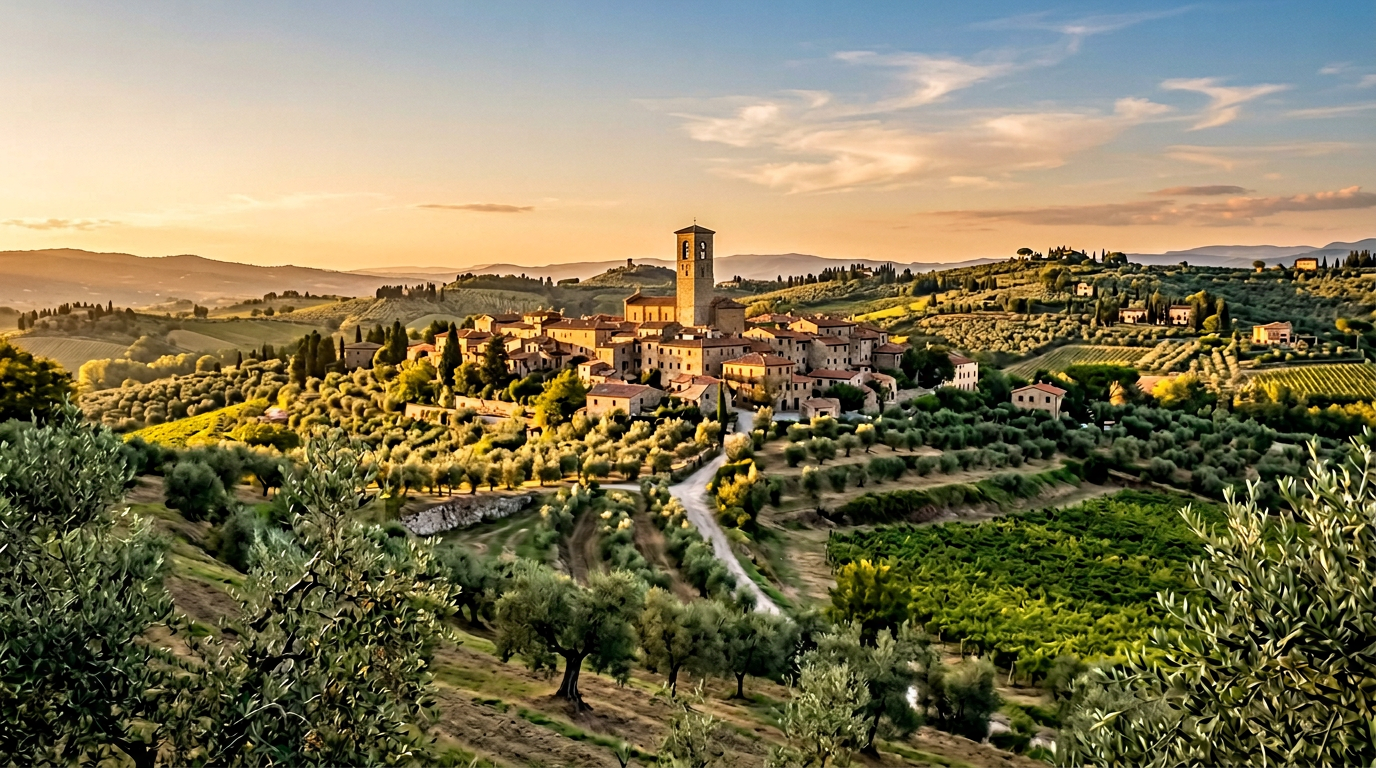
Tavarnelle Val di Pesa: Chianti wineries, Badia a Passignano, and the southern Chianti loop
Tavarnelle Val di Pesa is ten kilometres from Barberino Val d’Elsa and about twelve minutes by car on the SP20, heading north through vine-covered hills. The town sits at the heart of the Chianti Classico wine zone, surrounded by some of the most intensively planted Sangiovese vineyards in Tuscany. Since 2019, Tavarnelle and Barberino Val d’Elsa have been administratively joined into the municipality of Barberino Tavarnelle, but the two communities remain distinct in character and are still referred to separately by locals and on road signs.
Tavarnelle is not a classic Tuscan hilltop destination with towers and battlements. It is a working agricultural town with good food, a useful market, and a landscape that speaks for itself.
Tavarnelle Val di Pesa: what to do
The appeal of Tavarnelle is inseparable from its landscape. Step outside the town in any direction and you are in the Chianti Classico countryside: rows of Sangiovese on limestone hillsides, old stone farmhouses between the vines, cypress lines marking property boundaries and country lanes. This is the scenery that has made the Chianti one of the most recognised wine landscapes in the world.
The historic centre of Tavarnelle is modest and walkable in 20 minutes. The main street, Via Roma, connects the two ends of the town with a string of cafes, small shops, and a couple of restaurants. The Church of Santa Lucia, at the northern end of the street, has a simple Romanesque facade and a quiet interior worth a brief visit. The building dates from the medieval period, though the current form reflects later modifications.
On Friday mornings, a local market occupies the streets around the town centre. It sells seasonal produce, local cheese, fresh pasta, and a range of non-food goods. This is a working market for the local population rather than a tourist attraction, and prices and selection reflect that. Buying local olive oil, Pecorino, or fresh pici pasta here and taking it back to the guesthouse is a sensible use of 20 minutes.
The town functions as a good base for a day of cycling or walking in the surrounding Chianti countryside. The terrain is manageable for moderately fit cyclists, with good surfaces on most of the secondary roads and relatively light traffic except on weekends in summer.
The history of the village
The name Tavarnelle derives from the medieval word for tavern. The settlement grew along a historic road junction in the Val di Pesa because travellers needed stopping points between Florence and Siena, and this stretch of valley provided natural shelter and water. The taverns that gave the town its name served pilgrims, merchants, soldiers, and the agricultural workers who moved between estates in the valley.
The territory around Tavarnelle was contested ground during the long conflict between Florence and Siena that dominated the thirteenth and fourteenth centuries. The Florentines eventually consolidated control of the southern Chianti in the fifteenth century, and the agricultural landscape was gradually reorganised under Florentine landowners. The pattern of large estates, olive groves, and systematic vineyard planting that defines the Chianti today was largely set during the Medici period.
The merger of 2019 between Tavarnelle Val di Pesa and Barberino Val d’Elsa was driven by administrative efficiency: combining two small municipalities reduces the cost of services and allows shared investment in infrastructure. The combined municipality has approximately 9,000 residents.
Chianti Classico wineries
The area directly around Tavarnelle Val di Pesa contains some of the most significant Chianti Classico estates in the denomination. Chianti Classico is produced from a minimum of 80 percent Sangiovese grapes, grown within a strictly defined geographic zone between Florence and Siena. The denomination has three tiers: Chianti Classico, Chianti Classico Riserva (aged at least 24 months), and Gran Selezione (aged at least 30 months from specific vineyards). All bottles carry the Black Rooster seal of the Chianti Classico Consortium.
Antinori nel Chianti Classico, a few kilometres southeast of Tavarnelle near Bargino, is one of the most architecturally ambitious wineries in Europe. The building is partially buried in the hillside, with the cellar and visitor spaces carved into the terrain so that the vineyard flows over the roof. Tours and tastings are available by appointment. Entry-level tastings start at around 35 euros per person and include a selection of current vintages with guided explanation.
Isole e Olena, a smaller family estate near Tavarnelle, is respected across the Chianti Classico zone for producing wines of consistent quality. Their Chianti Classico and Cepparello (a Sangiovese IGT) regularly achieve top scores in international reviews. Visits are by appointment only and cost around 20 to 30 euros for a tasting.
Castello della Paneretta is housed in a converted medieval fortification and produces both Chianti Classico and wines from native Tuscan varieties including Canaiolo. The setting is picturesque and the wines are consistently made. Tastings by appointment, approximately 20 euros.
For a more casual experience without advance booking, the Enoteca del Chianti Classico in San Donato in Poggio, about six kilometres south of Tavarnelle, offers wines by the glass and bottle from a wide selection of local producers. You can taste and buy without reservation.
The Badia a Passignano abbey
The Badia a Passignano stands about five kilometres north of Tavarnelle in a fold of hills surrounded by vineyards and cypress trees. It is one of the most important Benedictine abbeys in Tuscany, and the landscape around it is among the most photographed in the entire Chianti.
The abbey was founded in the eleventh century and has been operated continuously by the Vallombrosan order, a Florentine Benedictine reform congregation founded in the same period. The monastic complex includes the main church, the residential buildings, and a set of late fifteenth-century frescoes by Domenico and Davide Ghirlandaio, depicting the Last Supper in the refectory. Tours of the interior are available on specific days, typically Saturday and Sunday afternoons. Check with the abbey for current access arrangements, which vary by season.
The surrounding vineyards belong to the Antinori family, who have owned the estate since 1987. The wines produced here under the Badia a Passignano label are among the most celebrated in the denomination.
The Osteria di Passignano, immediately adjacent to the abbey walls, is one of the finest restaurants in the Chianti. The menu is rooted in Tuscan tradition with significant refinement in technique and ingredient sourcing. The wine list focuses on Antinori wines from the estate and the broader portfolio. A full meal costs approximately 70 to 90 euros per person. Reservation is essential and should be made well in advance.
How to get there from Barberino Val d’Elsa
Tavarnelle Val di Pesa is ten kilometres from Barberino Val d’Elsa. The drive on the SP20 road heading north takes around 12 minutes. The road passes through the southern Chianti countryside with good views of the vineyard landscape on both sides.
There is no regular public transport between Barberino Val d’Elsa and Tavarnelle. The car is the only practical option for a day that includes visits to the surrounding wineries and the abbey.
From Tavarnelle, Florence is about 27 kilometres north, roughly 30 to 35 minutes by car on the SP20 and the Chiantigiana. This makes Tavarnelle a natural midpoint for a day that combines time in the Chianti countryside with an afternoon in the city.
Where to stay
Sogno d’Oro guesthouse is a short drive from Tavarnelle Val di Pesa, positioned in the Val d’Elsa countryside at the edge of the Chianti Classico zone. The surrounding landscape is the same rolling vineyard terrain that defines the character of the area. Several of the most interesting local estates are within ten minutes of the guesthouse by car.