One day in Siena: a practical guide to what to see
Siena is one of the great medieval cities of Europe, and one of the most complete. Where Florence changed dramatically through the Renaissance, the Baroque, and subsequent centuries of growth, Siena stayed largely still. The decision to remain medieval was partly forced — the city was hit devastatingly by the Black Death in 1348 and never regained its former commercial power — and partly a matter of civic pride. The result is a city that looks today almost exactly as it did six centuries ago.
One day in Siena is enough to understand why the city matters. It is not enough to exhaust it. But if you move with purpose and choose carefully, you can cover the essential sights and still have time to sit in a café and do nothing for an hour — which is itself part of understanding Siena.
The city is about 40 km from Barberino Val d’Elsa and around 35 minutes by car. That makes it one of the most accessible major day trips from the Val d’Elsa area.
Siena in one day: what to see
The historic centre of Siena is both compact and hilly. It sits on three ridge spurs meeting at Piazza del Campo, and walking between the main sights involves regular climbs and drops. Good footwear is not optional — the streets are paved with stone and some of the descents are steep.
The city is divided into 17 contrade, the neighbourhood districts whose rivalry structures Sienese civic life. Each contrada has its own symbol, colours, church, and museum. The horse race known as the Palio is the most visible expression of this rivalry, but it runs continuously below the surface of daily life. You will see the flags and symbols of each district everywhere as you walk through the city.
A sensible structure for a single day: start at Piazza del Campo in the morning when it is least crowded, move to the Cathedral complex by midday, spend the early afternoon in the surrounding medieval streets, and aim to leave by late afternoon before the evening traffic begins. Dinner in Siena is possible but requires planning — the good restaurants fill early.
Piazza del Campo and the Palio
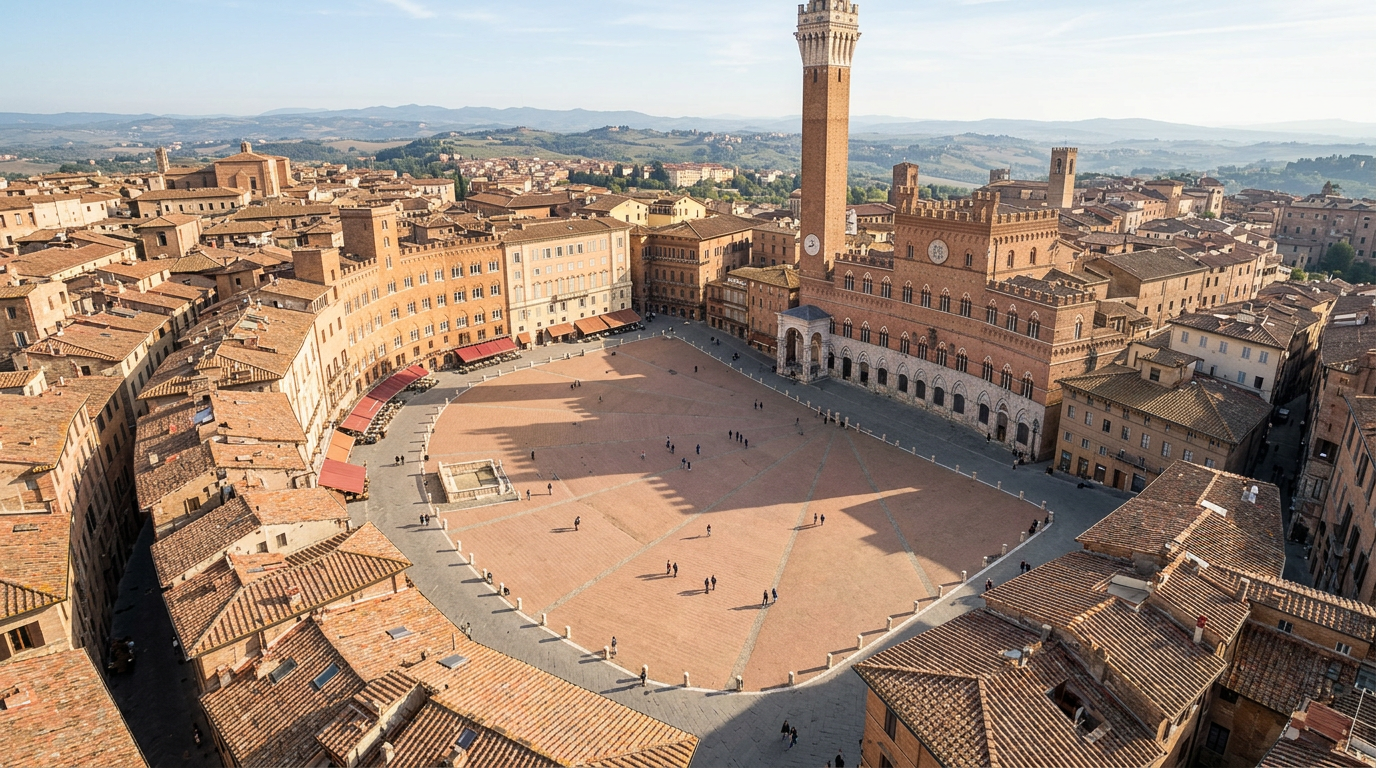
Piazza del Campo is the physical and emotional centre of Siena. There is no exact equivalent to it in any other Italian city. The space is shaped like a shallow shell, sloping gently down from three sides toward the Palazzo Pubblico on the straight lower edge. The paving is divided into nine segments by radiating lines of white marble — a reference to the Council of Nine that governed Siena during its medieval golden age.
The Torre del Mangia rises 88 metres from the side of the Palazzo Pubblico. It was completed in 1348, the year the plague arrived and interrupted everything. Climbing the tower costs around 10 euros and involves 400 steps with no elevator. The reward at the top is a panorama of the city’s rooftops, the surrounding countryside, and the hills of the Crete Senesi to the south. It is worth the climb.
The Palazzo Pubblico contains the Museo Civico, which is one of the most important collections of secular medieval painting in the world. The Sala del Mappamondo holds Simone Martini’s Maestà of 1315, a work of extraordinary refinement and scale. Next to it, the Sala della Pace contains Ambrogio Lorenzetti’s Allegory of Good and Bad Government, painted between 1338 and 1339. This fresco cycle is one of the most ambitious attempts in medieval art to represent the real consequences of political choices. Museum entrance costs around 10 euros.
The Palio di Siena takes place twice each year: on 2 July and 16 August. Ten of the seventeen contrade compete in each race, selected by a combination of rotation and lottery. The race itself lasts about 90 seconds, but the day surrounding it involves hours of processions, ceremonies, and pageantry. If you plan to visit during the Palio period, book accommodation months in advance and be prepared for large crowds everywhere in the city.
The Cathedral: what not to miss
Siena’s Cathedral is one of the most visually overwhelming churches in Italy. The exterior alternates bands of white and dark green marble — a Gothic tradition in Siena that creates a striped, vertically energetic effect unlike anything in Florence. The facade is layered with sculpture, mosaic, and architectural ornament accumulated over more than two centuries of construction.
Once inside, the eye is drawn immediately to the floor. The Cathedral’s pavement consists of 56 separate marble panel compositions, each depicting a scene from the Bible, classical mythology, or the tradition of the Sibyls. The panels are made from inlaid and engraved marble in multiple colours, and each one was designed by a different artist over a period of about 200 years. Most of the panels are covered for conservation except during a limited window each year, typically from mid-August through October. If your visit falls within that window, uncovering is an extraordinary experience.
The Piccolomini Library opens off the north aisle. It was commissioned in 1502 to house the books of Pope Pius II (Enea Silvio Piccolomini) and decorated by Pinturicchio with a cycle of ten frescoes depicting the pope’s life. The colours are among the most vivid of any Renaissance fresco in Italy — the blues, greens, and reds have survived in exceptional condition. Do not skip this room.
The full Cathedral complex includes the Baptistery (beneath the main building), the Crypt (which contains rediscovered 13th-century frescoes of remarkable quality), and the Museo dell’Opera del Duomo. A combined ticket for most of these costs around 15 euros and represents good value. Individual tickets are available but less flexible. Hours vary seasonally; the Cathedral is generally open from 10:00 to 17:30 Monday through Saturday and from 13:30 to 17:30 on Sundays.
The medieval Gothic centre
Beyond the Campo and the Cathedral, Siena rewards walking without a fixed destination. The streets between the main sights are full of medieval palazzi, neighbourhood churches, and the flags and colours of the contrade.
Via di Città connects the Campo to the Cathedral along the upper ridge of the central spur. This is one of the most architecturally consistent medieval streets in Italy. Palazzo Chigi-Saracini, on this street, is one of the most elegant 14th-century palaces in the city and today houses a music academy that sometimes holds public concerts.
The neighbourhood of Terzo di Camollia, north of the Campo, is the least touristy area of central Siena. The pace slows here. The Basilica di San Francesco and the Church of Sant’Agostino are both worth brief visits — the frescoes in Sant’Agostino include a work by Sodoma, the 16th-century Sienese painter.
For lunch, Osteria Il Vinaio on Via dei Termini is small, honest, and reliable at around 20 to 25 euros per person. For something more ambitious, Osteria le Logge on Via del Porrione is among the finest traditional restaurants in the city, with a wine list strong on local bottles. Expect around 40 to 50 euros per person.
The local pastry culture is strong. Ricciarelli are soft almond biscuits dusted with icing sugar — delicate and addictive. Panforte is a dense, spiced cake packed with dried fruit, nuts, and honey. Both have been made in Siena for centuries and are available in most pasticcerie and specialty food shops throughout the centre.
How to get there from Barberino Val d’Elsa
Siena is approximately 40 km from Barberino Val d’Elsa. Driving south on the SR2 (Via Cassia) takes around 35 minutes under normal conditions. The road runs through the Chianti countryside and is efficient and easy to navigate.
By train, the closest station to Barberino Val d’Elsa is Poggibonsi-San Gimignano. Trains run from Poggibonsi to Siena in about 30 minutes and cost around 4 to 5 euros. Getting to Poggibonsi from Barberino requires either a short drive (12 km) or a bus connection.
Long-distance buses operate between Florence and Siena and stop at various points along the route. These are comfortable and frequent, and worth considering if you are arriving from Florence rather than from the Val d’Elsa.
If driving directly to Siena, note that the ZTL (restricted traffic zone) covers the entire historic centre. You cannot drive into the old town without a permit. Park in the car parks outside the walls — Il Campo and Santa Caterina are the most convenient for the main sights. Expect to pay around 2 to 3 euros per hour.
Where to stay
Sogno d’Oro is located near Barberino Val d’Elsa in the Val d’Elsa countryside. Siena is less than 40 minutes away by car, which means you can visit without the pressure of an early start or a long motorway drive.
The experience of returning to a quiet rural setting after spending a day immersed in Siena’s dense, history-saturated centre is one that most travellers find unexpectedly satisfying. The contrast is part of what the Val d’Elsa offers.