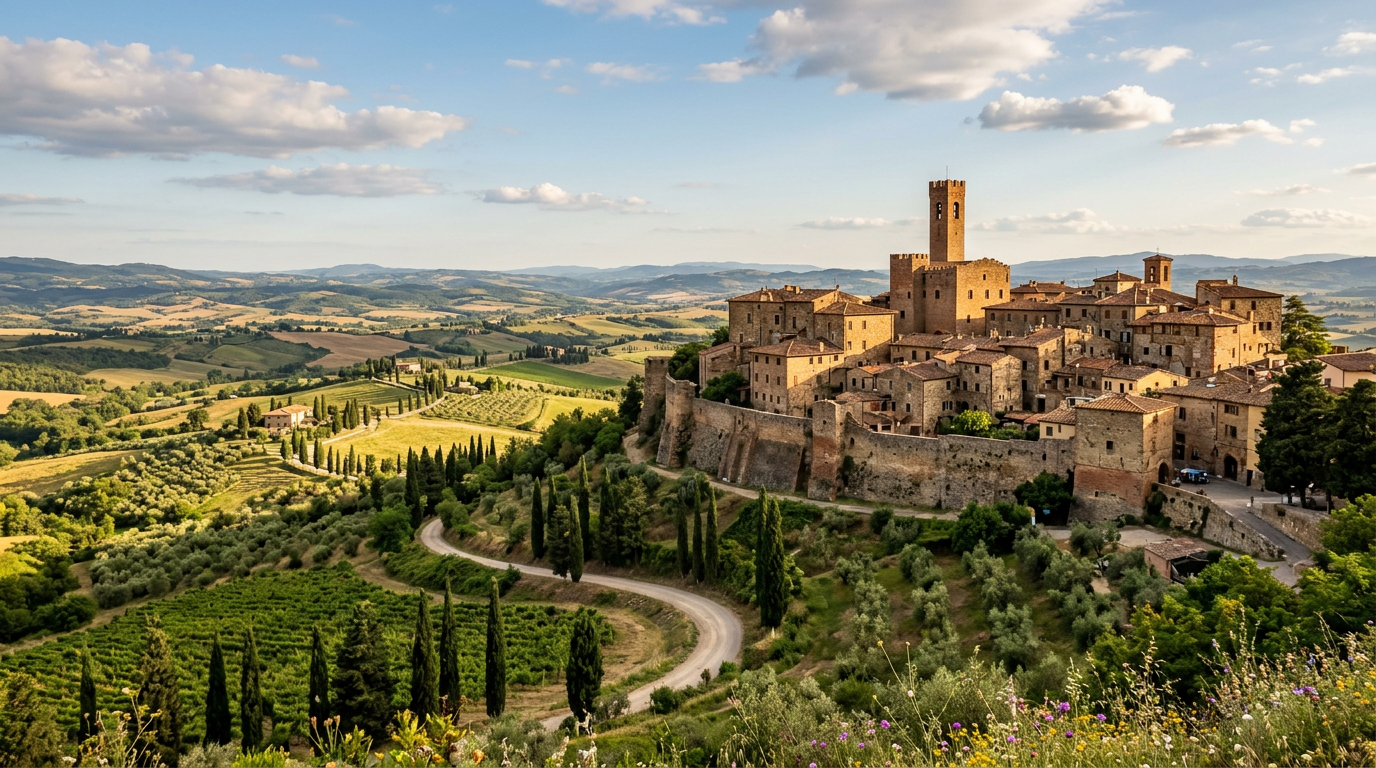
Certaldo: Boccaccio's town and its medieval heart
Certaldo is 12 km from Barberino Val d’Elsa and about 15 minutes by car. Of all the worthwhile destinations within easy reach of the Val d’Elsa, it is the one that most consistently surprises visitors who go in without high expectations. The medieval upper village — reached by funicular from the lower modern town — is built from warm red brick rather than the grey stone typical of most Tuscan hilltowns, and that single material difference changes the atmosphere of the entire place. In good afternoon light, the walls glow. At dusk, the village acquires a quality that is hard to name and easy to remember.
Certaldo is also a town with a specific literary identity. Giovanni Boccaccio, author of the Decameron, spent his final years and died here. His house, his tomb, and the medieval streets he walked are still here. For anyone interested in medieval European literature or simply in the texture of 14th-century Italian life, Certaldo is a direct encounter.
Certaldo: Boccaccio’s town
Giovanni Boccaccio was born around 1313 — the exact birthplace is debated, with both Certaldo and Florence claiming him — and spent much of his adult life moving between the two cities. He returned definitively to Certaldo in his later years and died here in 1375. The town has since built its identity substantially around that connection.
The Decameron, completed around 1353, stands as one of the most influential works in European literary history. Written in the immediate aftermath of the Black Death of 1348, it consists of 100 stories told by ten young Florentines sheltering from the plague in a country villa outside the city. The stories range across every register — tragic, comic, erotic, moral — and Boccaccio’s vernacular Italian prose became a model that shaped European storytelling for centuries. Chaucer knew the Decameron. Shakespeare drew on it. The line of influence runs direct from 14th-century Certaldo to modern European fiction.
In Certaldo Alto you can visit Boccaccio’s house, see his tomb in the parish church, and walk the streets he inhabited. The medieval atmosphere of the upper town is sufficiently well preserved to make the visit feel like genuine contact rather than museum recreation.
Certaldo’s most popular annual event is the Mercantia, a street theatre festival that fills Certaldo Alto with performers, musicians, and markets for several days each July. The combination of the medieval setting and the festival atmosphere draws large crowds. If your visit coincides, plan to arrive early in the day before the crowds build.
Certaldo Alto and Certaldo Basso
Certaldo divides clearly between its upper and lower halves. Certaldo Basso occupies the valley floor and is a modern, practical town. It has a train station on the Florence-Siena local line, shops and restaurants, the lower funicular terminus, and parking near the station. Nothing here requires a prolonged visit, but it is the operational base from which you access Certaldo Alto.
Certaldo Alto sits on the ridge above, connected to the lower town by both funicular and a steep road. The medieval village is compact — about 400 metres long — but very densely built. Walking from one end to the other takes ten minutes on the main street. Following the side alleys and doubling back through the lanes can occupy an hour and a half without ever feeling repetitive.
The brick construction is the defining characteristic. Most buildings in Certaldo Alto are built from red-brown brick fired locally, which gives the village a visual warmth unlike the stone-built hilltowns of the Val d’Elsa and Chianti. The brickwork is consistent across centuries of construction, which gives Certaldo Alto an unusual coherence.
The main street, Via Boccaccio, runs straight through the centre of the upper village from the main gate to the far end. Off it, narrow lanes lead to small courtyards, unexpected viewpoints over the valley, and the occasional private garden glimpsed through an open gate.
The funicular and medieval centre
The funicular between Certaldo Basso and Certaldo Alto runs every 15 to 20 minutes during operating hours. A single ticket costs 1.50 euros. The three-minute ride rises steeply from the station in the lower town and deposits you directly onto the main street of Certaldo Alto, close to the Palazzo Pretorio.
For visitors arriving by car, the most straightforward approach is to park near the train station in Certaldo Basso and take the funicular from there. Parking near the station is free or very cheap. If the funicular is not operating, a paved road also reaches Certaldo Alto from below, with limited parking near the upper gate.
The Palazzo Pretorio is the first major building you encounter from the funicular exit. Its facade is covered with ceramic coats of arms representing the governors sent by Florence during the centuries of Florentine rule. The effect is colourful and unusual — dozens of distinct heraldic shields in blue, red, and yellow covering most of the facade. The interior contains the Museo Civico, with local history exhibits and a reconstruction of the room where Boccaccio is believed to have lived in his final years. Entry costs around 6 euros.
Further along Via Boccaccio stands the Church of Santi Jacopo e Filippo. This is one of the oldest buildings in the upper village and contains Boccaccio’s tomb. A Latin inscription marks the burial site. The interior is simple, slightly austere, and appropriately medieval in character.
From the southern end of the village, the wall walk provides views in both directions over the Val d’Elsa and toward the Chianti hills. On a clear day, San Gimignano’s towers are visible to the south-west, about 15 km away.
Boccaccio’s house
Casa Boccaccio on Via Boccaccio is the house museum dedicated to the writer. The original building was significantly damaged during the Second World War and was carefully reconstructed in the 1960s on the same site. The reconstruction maintains the medieval character of the surrounding street and the building’s relationship to its neighbours.
The museum inside covers Boccaccio’s life from his early years in Florence and Naples through his mature literary output and his final decades in Certaldo. The exhibition includes reproductions of manuscript pages from the Decameron and other works, historical maps, and documentary material about 14th-century Italian life.
The Decameron predated the printing press by a century, yet it circulated widely across Europe within decades of its completion. The museum explains the mechanisms of manuscript circulation in medieval Italy and why Boccaccio’s choice to write in vernacular Florentine Italian rather than Latin made the work accessible in a way that formal scholarly writing was not.
Entrance to Casa Boccaccio costs around 5 euros. Combined tickets with the Palazzo Pretorio are available at modest savings. The museum is open daily except Mondays. A small garden behind the house has a few benches and looks out over the valley — a good place to sit quietly before continuing through the village.
Where to eat in Certaldo
Certaldo Alto has a small but reliable restaurant selection. The most notable address is Osteria del Vicario on Via Rivellino, which occupies a converted medieval convent with a cloister garden. The kitchen focuses on Tuscan food made with local ingredients, and the setting — stone arches, a quiet courtyard, a view over the valley from the garden tables — is exceptional. Expect to spend around 35 to 45 euros per person including wine.
Along Via Boccaccio there are a couple of smaller bars and enotecas that serve sandwiches, wine by the glass, and light meals. These are good for a quick lunch or a mid-afternoon break without the commitment of a full restaurant meal.
In Certaldo Basso, several trattorie and pizzerias near the station area offer straightforward local food at lower prices. A practical option if you arrive early and want to eat before heading up to the upper village.
How to get there from Barberino Val d’Elsa
Certaldo is 12 km from Barberino Val d’Elsa. The drive takes about 15 minutes on the SP1 north-west along the Val d’Elsa. The road is easy and mostly flat until the final approach to Certaldo.
Park in Certaldo Basso near the train station. The funicular station is close by, and the ride up takes three minutes. Total time from parking to Certaldo Alto: about ten minutes.
By train from Florence, Certaldo is on the local Florence-Siena line. The journey from Florence Santa Maria Novella takes approximately 35 minutes and costs around 5 to 6 euros. The train arrives in Certaldo Basso, directly connected to the funicular.
From Barberino Val d’Elsa there is no convenient direct bus to Certaldo. The car or bicycle is the practical option for this excursion.
Where to stay
Sogno d’Oro is located near Barberino Val d’Elsa in the heart of the Val d’Elsa. Certaldo is close enough to visit in the early morning before other visitors arrive, or in the late afternoon when the light on the brick facades is at its best and the streets have quietened. The drive back to the guesthouse takes 15 minutes through the same valley that Boccaccio wrote about in the 14th century.