Val d'Orcia what to see: a practical one-day itinerary from Barberino
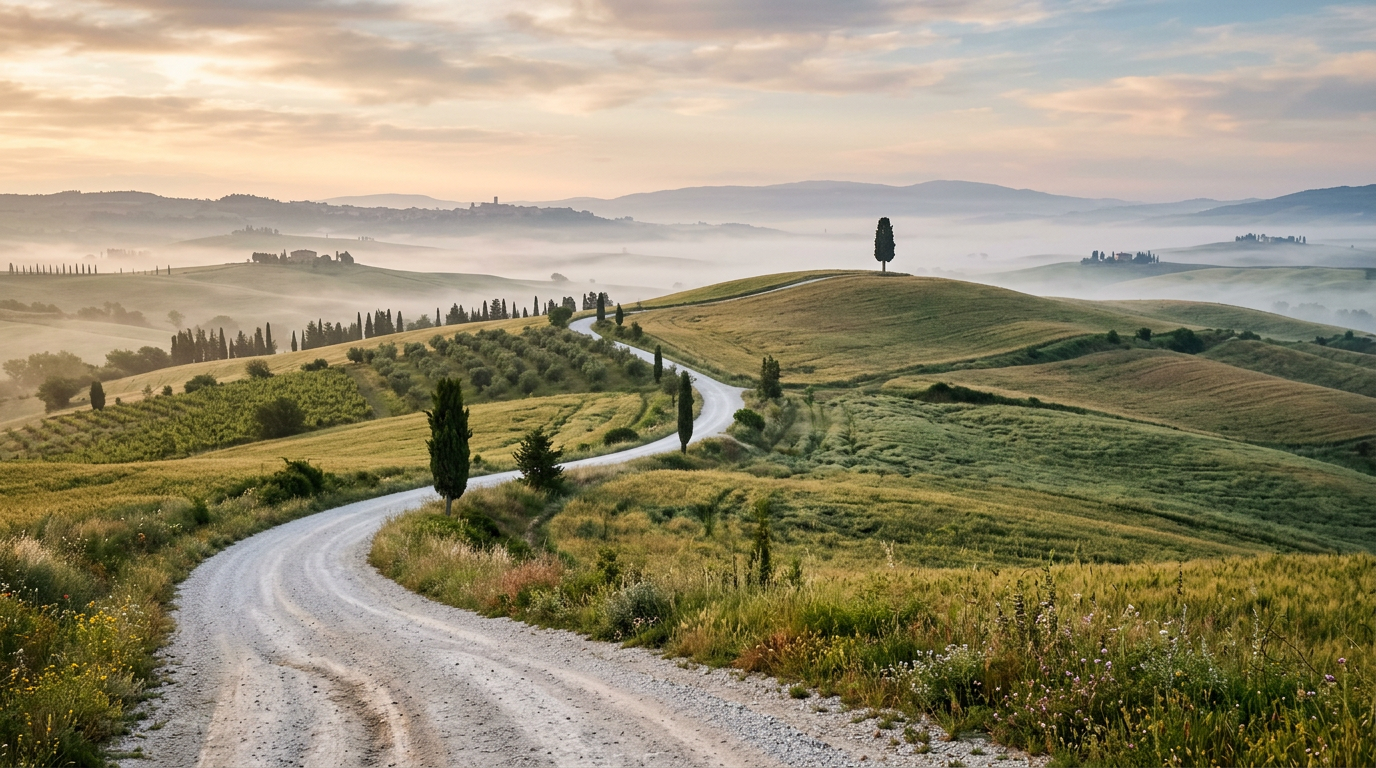
The Val d’Orcia is the kind of landscape that makes you reconsider the word beautiful. The rounded clay hills, the isolated farmhouses on ridgelines, the rows of cypress trees used as windbreaks along field boundaries, the quality of light at any season — it all combines into something that does not reduce to a single photograph or a single visit.
The Val d’Orcia is a UNESCO World Heritage Site in the southern province of Siena. Its defining quality is not a single monument but the managed agricultural landscape itself — the way centuries of human work and natural geography have produced a scene of continuous visual richness. From Barberino Val d’Elsa the drive to the edge of this landscape takes about 60 minutes and covers roughly 70 km. This makes a full day in the Val d’Orcia entirely feasible, with enough time to see the main towns and some of the quieter roads without feeling rushed.
Val d’Orcia: a one-day itinerary
Leave Barberino Val d’Elsa by eight in the morning. The SR2 Cassia south through the Crete Senesi — the eroded clay hills that begin just south of Siena — is worth experiencing slowly. The landscape shifts from the wooded Chianti hills to open, pale, almost lunar terrain. Stop once where the road allows for an unobstructed view.
By nine-thirty, arrive in San Quirico d’Orcia. Spend an hour in the town: walk through the main gate, visit the Collegiate Church portals, and rest in the Horti Leonini garden. Then drive the 5 km to Bagno Vignoni to see the thermal pool in the central square and, if time allows, walk down to the gorge below.
By eleven-thirty, drive the 26 km west to Montalcino. Arrive before midday, when the town is already busy but not yet at full capacity. Have lunch in the town centre or at a nearby trattoria. After lunch, visit the Rocca fortress and taste wine at the enoteca inside. If you have pre-booked a winery visit, arrange it for the early afternoon.
By four in the afternoon, drive the 25 km east to Pienza. The late afternoon light in the Val d’Orcia is the best of the day — warm and directional, throwing long shadows across the clay hills. Walk the main street and the Piazza Pio II. Buy cheese.
Leave Pienza by five-thirty. The return route via San Quirico and north on the SR2 brings you back to Barberino by seven. The day covers about 200 km in total but the driving is comfortable and the roads are largely uncongested outside summer weekends.
Pienza and Montalcino not to miss
Pienza is the architectural centrepiece of the day. The entire historic centre was designed by a single architect — Bernardo Rossellino — in three years between 1459 and 1462, on the orders of Pope Pius II who wanted to transform his birthplace into an ideal Renaissance city.
Piazza Pio II is the heart of the project: a space where the cathedral, the Palazzo Piccolomini, the Bishop’s Palace, and the Town Hall all face each other according to a consistent proportional system. The effect of standing in this square is one of unusual coherence — everything here was planned, and the plan still works.
The town is equally famous for its pecorino cheese. Corso il Rossellino, the main street, is lined with specialist shops selling sheep’s milk cheese at every stage of ageing. Allow 20 minutes for browsing and tasting before you buy.
Montalcino provides the counterpoint. Where Pienza is polished and architectural, Montalcino is quieter and more focused on a single subject: wine. The Rocca fortress at the southern end of town is the best viewpoint, and the enoteca inside it is the most useful introduction to Brunello di Montalcino for visitors who have not tasted it before. A flight of three wines at around 12 to 18 euros gives you the essential reference points without requiring a full cellar visit.
San Quirico d’Orcia and Bagno Vignoni
San Quirico d’Orcia is a small medieval town on the Via Francigena — the pilgrimage route from Canterbury to Rome — and was an important stopping point for centuries of travellers moving south through Tuscany.
The Collegiate Church of SS. Quirico e Giulitta, standing on the main road through town, has three carved portals from different periods of the Romanesque, each using a different visual language. The central portal, with twisted columns on lions and carved figures, is the most elaborate. The interior is austere and calm, with a polyptych by Sano di Pietro and a quality of quiet that makes it one of the better small churches in Tuscany.
The Horti Leonini, a formal Italian garden laid out in 1580 on the southern edge of the historic centre, is free to enter. The geometric hedges of holm oak and box provide shade and shelter. In autumn the garden turns gold and amber at the edges.
Bagno Vignoni, 5 km south of San Quirico, is genuinely unusual. The central square of the village is occupied entirely by a large thermal basin built during the Renaissance. The water is no longer available for bathing in the main pool but remains full and steaming. Walking into a village and finding hot water where you expect paving stones is an experience that holds up even after you have read about it in advance.
Below the village, a walking path descends into the gorge of the Orcia river, passing the old mill and the natural hot springs at the base of the cliff. The walk takes 20 to 30 minutes.
Val d’Orcia scenic roads
The SP146 between San Quirico d’Orcia and Chianciano Terme is the most photographed road in the Val d’Orcia. The section near the Cappella di Vitaleta — a small chapel in a cypress grove visible from the road — appears in more travel photographs of Tuscany than almost any other spot. It earns its reputation. The combination of the lone chapel, the cypress rows, and the open clay hills behind it condenses the visual character of the Val d’Orcia into a single frame.
Conditions for photographing the chapel are best in the early morning or late afternoon. At midday in summer the shadows are flat and the light is harsh. The chapel is surrounded by private farmland. Respect the boundaries and stay on the road.
The road from Montalcino south toward Sant’Angelo in Colle, through vineyard-covered slopes, offers quieter and equally beautiful views. This route passes working estates rather than the most-visited spots and sees a fraction of the traffic on the SP146.
The approach to Monticchiello from the north on the road from Montepulciano is another largely unknown scenic route through open farmland with views that are easily as dramatic as the more famous spots.
How to get there from Barberino Val d’Elsa
Take the SR2 Cassia south from Barberino Val d’Elsa. Pass through Siena on the raccordo ring road following signs for Buonconvento. Continue south through Buonconvento toward the Val d’Orcia. At Torrenieri you can branch west toward Montalcino or continue south-east toward San Quirico d’Orcia.
Total distance to San Quirico d’Orcia: approximately 70 km. Drive time: approximately 60 minutes.
A car is essential. Public transport between the Val d’Orcia villages is minimal and makes it impossible to see more than one or two places in a day.
Start with a full tank from Barberino. Petrol stations in the Val d’Orcia interior are infrequent.
Where to stay
Sogno d’Oro in Barberino Val d’Elsa sits 60 minutes from the edge of the Val d’Orcia. The drive south through the Crete Senesi is a landscape journey in itself. The guesthouse puts you close enough to make a full day in the Val d’Orcia comfortable, without pushing you so far south that you lose the Chianti landscape that makes the northern part of Tuscany equally extraordinary.