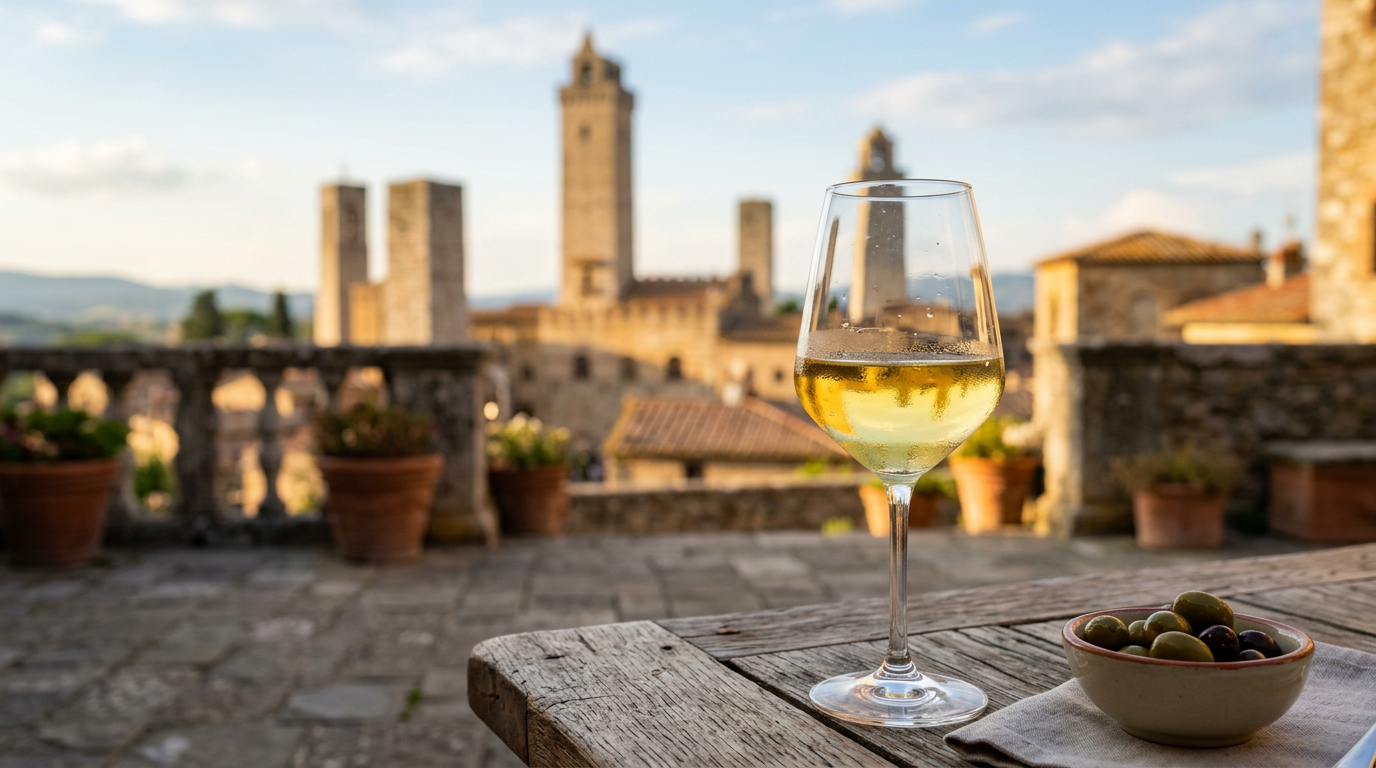
Vernaccia di San Gimignano: Tuscany's finest white wine
When most people think of Tuscan wine, they think of red. Brunello, Chianti Classico, Vino Nobile di Montepulciano — the reds dominate the conversation. Vernaccia di San Gimignano stands alone as the exception: a white wine of genuine substance and a history stretching back to the medieval period. It is dry, mineral, and possessed of a slightly bitter finish that sets it apart from virtually every other Italian white. For a region that built its wine reputation on Sangiovese, Vernaccia is a remarkable outlier.
San Gimignano is roughly 28 km from Barberino Val d’Elsa — about 30 minutes by car. The town draws large visitor numbers year-round, and the towers are rightly famous. But wine is the serious business here, and beyond the tourist shops selling ceramics and saffron, there is a wine culture with real depth.
Vernaccia di San Gimignano
Vernaccia di San Gimignano holds a specific place in Italian wine history: it was the first wine in Italy to be awarded DOC status, in 1966. That recognition came not as a marketing exercise but as acknowledgment of a long-established reputation. The wine was elevated to DOCG in 1993, joining the small group of Italian wines judged to have met the highest standard of quality and regional distinctiveness.
The Vernaccia grape is native to San Gimignano and genetically distinct from the Vernaccia varieties grown elsewhere in Italy. Vernaccia di Oristano in Sardinia, for example, bears the same name but is an entirely different grape with a completely different character. The San Gimignano version is crisp, medium-bodied, and strongly influenced by the altitude and mineral-rich soils of the surrounding hills.
There are two main styles. The standard Vernaccia is made for drinking young. It shows fresh aromas of green apple, pear, white flowers, and almond, with that characteristic mineral bitterness on the finish. It is refreshing and precise without being light or simple.
The Riserva is a more ambitious wine. It requires a minimum of 11 months of aging, including at least four months in wood. The wood adds weight and complexity, shifting the flavour profile toward stone fruit, honey, and oxidative notes. The colour deepens to a richer gold. Riserva Vernaccia suits richer dishes and rewards patience at the table.
The most famous Tuscan white wine
Vernaccia di San Gimignano’s reputation is ancient. Dante mentions it in the Purgatorio, and 14th-century merchants listed it among the finest wines available in Florence. During the height of the medieval trade routes, San Gimignano sat directly on the Via Francigena, the pilgrimage road connecting northern Europe to Rome. Vernaccia was one of the main exports moving through this prosperous merchant town.
The 20th century was not kind to Vernaccia. Mass production and poor winemaking damaged the wine’s standing, and by mid-century it had largely been dismissed as a minor curiosity. The rehabilitation began in the 1980s, when a group of producers committed to quality over volume. They replanted vineyards, modernised cellars, and brought the wine back to the level its history justified.
Today the DOCG zone covers approximately 850 hectares of vineyard in the hills surrounding San Gimignano. Around 70 producers are registered with the Consorzio della Vernaccia di San Gimignano, which organises quality controls and promotion. The Vernaccia di San Gimignano Wine Experience, a museum in the town centre, documents the wine’s story from medieval times to the present day.
The production zone sits at altitudes between 200 and 450 metres. The soils are a mix of clay and silt with good mineral content. This combination — altitude, drainage, and minerals in the ground — gives Vernaccia its characteristic finish and prevents it from becoming a soft, fruit-forward white wine.
Wineries where to taste it
Several estates in the San Gimignano area are well organised for visitors and represent the range of Vernaccia styles well.
Teruzzi was one of the pioneers of modern Vernaccia. The estate, about 3 km from town, played a central role in rebuilding the wine’s reputation during the 1980s and 1990s. The tasting room is professional and the range broad. Walk-in visits are generally possible; guided tastings start at around 15 euros.
Panizzi, near Racciano about 6 km from San Gimignano, is considered one of the finest addresses in the DOCG. The Riserva here is exceptional — complex, long, and worth buying. Visits by appointment. A tasting costs around 20 euros and typically includes the full range.
Falchini has been making Vernaccia since the 1960s from an estate about 4 km outside town. The wines are honest and fairly priced. Appointments are preferred but the estate is not strict about it outside the high season.
Il Colombaio di Santa Chiara, near the town walls, is a smaller, more intimate producer whose standard Vernaccia is delicate and aromatic. The estate also makes a good Rosso di Sangimignano from Sangiovese. Visits by appointment.
For a sampler without committing to a single estate, the Vernaccia di San Gimignano Wine Experience offers structured comparative tastings with food pairings. The entry fee runs from 12 to 18 euros depending on the tasting level selected. The museum section covers the wine’s history and the town’s medieval commercial life.
How to pair Vernaccia
Vernaccia di San Gimignano is built for food. The mineral bitterness that defines it serves a practical purpose at the table: it cleans the palate and sharpens the appetite in a way that softer whites do not.
The most natural pairings are with fish and shellfish. Grilled sea bass, steamed clams, mussels in white wine, or a simple spaghetti alle vongole are all ideal matches. The wine’s acidity cuts through the natural fat of the seafood and the mineral finish keeps the pairing fresh from first glass to last.
With Tuscan food more broadly, Vernaccia works remarkably well with crostini toscani — the classic chicken liver crostini that open almost every local meal. The wine handles the intensity of the liver and the butter of the toast without being overwhelmed. It pairs equally well with fresh pecorino, mild salumi, and light white bean soups.
The Riserva opens up a different set of possibilities. Its weight and complexity handle richer flavours: pasta with truffle, risotto with porcini, roasted white meats. The oxidative edge in a well-made Riserva is particularly good with aged cheese — the wine and the cheese develop a shared savouriness that neither achieves alone.
As an aperitivo, the standard Vernaccia is excellent. Its moderate alcohol (usually 12 to 13 percent), clean freshness, and slight bitterness make it the perfect wine to drink before a meal rather than with one.
Serving temperature matters more than most people acknowledge. Standard Vernaccia is best between 10 and 12 degrees Celsius — cold enough to be fresh, warm enough to show the aromas. The Riserva can be served slightly warmer, around 12 to 14 degrees, to allow the more complex notes to open.
How to get there from Barberino Val d’Elsa
San Gimignano is 28 km from Barberino Val d’Elsa. The drive takes approximately 30 minutes and is straightforward.
Head south-west from Barberino on the SR2 as far as Poggibonsi, then turn west on the SP1 toward San Gimignano. The road climbs through vineyard country as it approaches the town. The first view of the towers appearing on the skyline ahead is one of those Tuscan moments that does not disappoint even on a second or third visit.
Parking is outside the town walls. The main options are at Porta San Giovanni to the south, Porta San Matteo to the north, and Piazzale Martiri di Montemaggio. Plan to pay around 2 euros per hour or 8 to 10 euros for a full day. In summer, car parks fill by 10:00. Arriving before 9:30 or waiting until after 17:00 significantly reduces congestion.
Bus services connect San Gimignano to Poggibonsi, Florence, and Siena. From Barberino Val d’Elsa, a change at Poggibonsi is necessary. Total journey time by bus is around 45 to 60 minutes. The bus is a practical option if you want to avoid driving after a winery visit.
Where to stay
Sogno d’Oro sits in the Val d’Elsa near Barberino Val d’Elsa, placing San Gimignano 28 km to the west — one of the most straightforward day trips from the guesthouse. Spend the morning among the towers and in the wineries, return by early afternoon, and you are back in the quiet of the valley with time to spare.
The difference in atmosphere between San Gimignano’s summer crowds and the unhurried pace of the Val d’Elsa countryside is as striking as any contrast Tuscany offers.