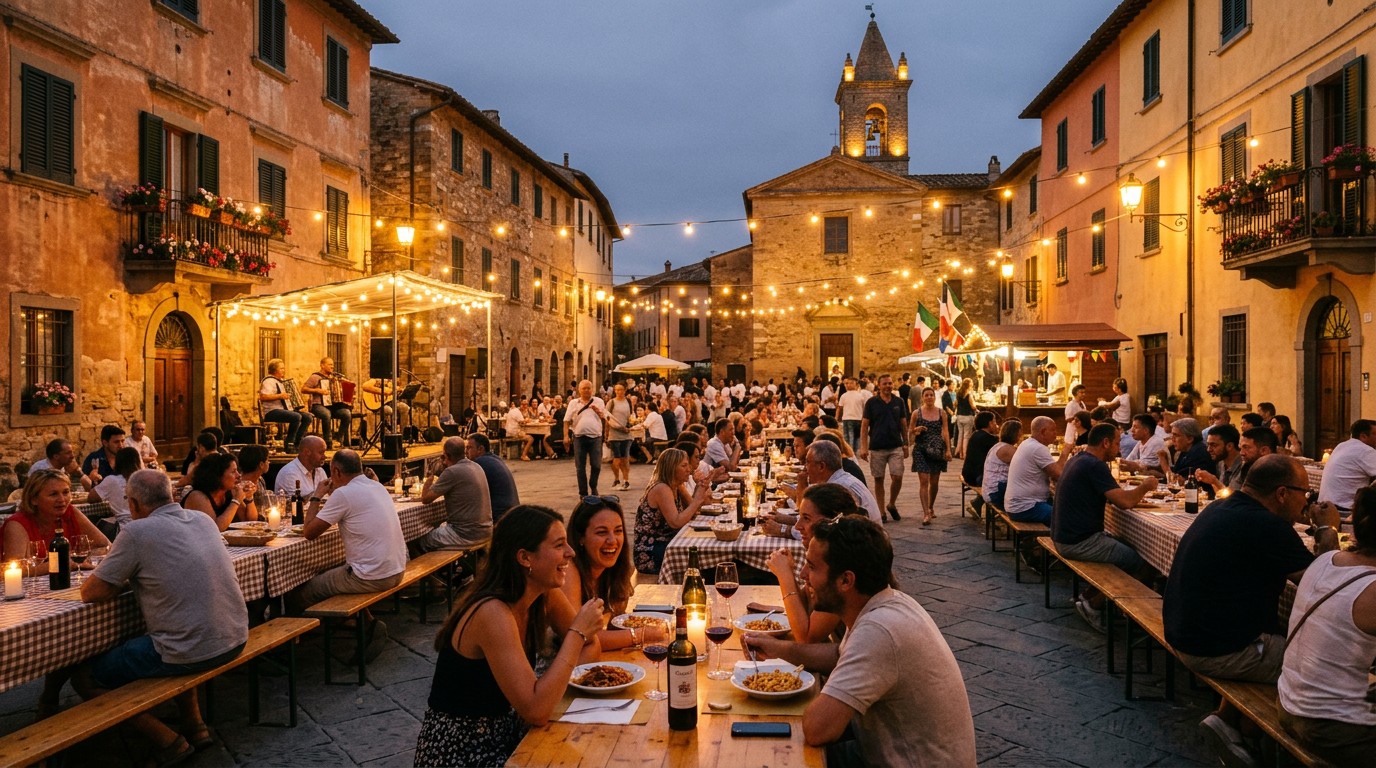
Val d'Elsa local festivals 2026: sagre, food, and how to find them
A sagra is a village food festival organised by the local Pro Loco association or a network of volunteers. It is not a food fair designed for tourists, not a curated culinary event with ticket tiers and celebrity chefs, and not a commercial promotion disguised as tradition. It is, at its best, a community dinner that happens outdoors, focuses on one food or tradition specific to the area, and runs on the energy of people who live there and want to share something they are proud of.
The Val d’Elsa between Barberino Val d’Elsa and the Siena plain has a dense calendar of these events from May through October. If you are staying in the area and you are present on the right weekend, there is a very good chance that something is happening within 15 minutes of you by car.
Val d’Elsa local festivals in 2026
The sagra calendar in the Val d’Elsa follows the rhythm of the agricultural year and the patterns established over decades of community organisation. Spring events start tentatively in late April or May, often tied to olive oil, asparagus, or the first local wines. The summer months are the most active, with multiple events across the valley in June, July, and August, most of them running on Friday and Saturday evenings. Autumn brings the harvest festivals in September and October, followed by events centred on mushrooms, truffles, and the new olive oil pressing in November.
Each sagra is self-organised. There is no umbrella calendar that tracks all events centrally, which is one of the things that makes them feel genuine and also one of the reasons finding them requires a bit of local knowledge. Events are confirmed late — sometimes only two weeks before they happen — because they depend on volunteer availability, weather forecasts, and the condition of whatever local product is being celebrated.
The atmosphere at a well-attended sagra is unlike anything organised for visitors. Long communal tables fill with local families. Children run between the benches. Groups of friends share bottles of wine poured from a jug. The conversation is loud and in Italian. Strangers are consistently friendly to visitors who make any effort to engage. Having a few words of Italian is useful; having none is not a barrier if you are willing to point at the menu board and smile.
The festivals not to miss
The sagra della bistecca is one of the most celebrated recurring events in the Chianti and Val d’Elsa area. Enormous T-bone steaks from Chianina cattle — the large white Tuscan breed that produces the finest bistecca alla Fiorentina — are grilled over wood fires and sold by weight to lines of customers who queue patiently while the smoke from the grill rises into the warm evening air. The setting is typically a sports ground, a village car park, or an open field at the edge of town. The experience is loud, smoky, and deeply satisfying.
Certaldo, 12 kilometres north of Barberino, holds several significant summer events. The Mercato Medievale, a medieval market and re-enactment staged in the brick-built upper town, is one of the most visited events of this type in the Val d’Elsa and typically runs over a long summer weekend. Certaldo also has a strong tradition of food events in the historic upper town, particularly tied to the cipolla di Certaldo, a local onion variety grown in the valley that is the subject of considerable local pride and has IGP geographical indication status.
San Donato in Poggio, eight kilometres from Barberino, is a small walled medieval village that organises events around the grape harvest in September. The village fills with visitors and locals for what is, in scale, a modest event but, in atmosphere, a concentrated expression of Chianti wine culture in its home landscape. The medieval streets, the stone buildings, and the smell of newly pressed wine all contribute.
Tavarnelle Val di Pesa, eight kilometres from Barberino, holds its own summer festivals including pasta-making events and grilled meat evenings that attract a mix of nearby residents and visitors from further afield. These are less associated with a single prestige product than the Certaldo or San Donato events and are more accessible in tone.
Poggibonsi, ten kilometres south of Barberino, hosts the Palio di Poggibonsi, a historical pageant and community event, along with various neighbourhood festivals and sagre through the summer months.
What you eat at local festivals
The menu at a Val d’Elsa sagra is rooted in Tuscan home cooking and priced for the local population. A full meal with a first course, a second course, bread, and a glass of house wine typically costs between eight and fifteen euros per person. This is not cheap in absolute terms but it is extremely good value for what you receive.
Starters commonly include bruschetta rubbed with garlic and dressed with the local olive oil, crostini con fegatino (chicken liver spread on toasted bread, a Tuscan staple), panzanella in summer (a bread salad with tomato, onion, and basil), or ribollita when the weather is cooler.
First courses are almost always pasta. Pici al ragù is the most characteristic of this area: pici is a thick hand-rolled pasta specific to the Sienese tradition, made from flour and water without egg, and the ragù is typically made from wild boar or beef. Pappardelle with wild boar sauce is another fixture. In summer you might find pasta al pomodoro with local tomatoes, straightforward and excellent when the tomatoes are genuinely ripe.
Second courses feature grilled and roasted meat. Bistecca from Chianina cattle is the prestige choice. Sausages (salsiccia), roasted pork (arista), roasted chicken (pollo arrosto), and trippa (tripe stewed with tomato) appear on different menus depending on the village and the theme of the event.
House wine is served in ceramic jugs or carafes, usually a simple local Sangiovese or a white from the Vernaccia di San Gimignano area. It costs one to two euros per glass. Desserts are unpretentious: cantucci with a small glass of vin santo, fruit tart, or crostata with fig or apricot jam.
How to find the updated calendar
There is no single authoritative calendar for Val d’Elsa sagre. Events are confirmed late and information is dispersed across many local sources, most of which are not updated in real time by any regional authority.
The Pro Loco websites for individual towns are the most reliable online source. The Pro Loco associations of Barberino Tavarnelle, Certaldo, Colle di Val d’Elsa, Poggibonsi, and San Casciano Val di Pesa all maintain their own event pages. Check these in the week before your stay.
The Toscana Promozione Turistica website and regional tourism portals sometimes list major sagre but are often incomplete and lag behind the actual local calendar by weeks.
Physical notice boards in village centres are highly reliable. The poster for a local sagra — often an A4 sheet printed at the local copy shop — goes up on the church notice board, the bar wall, and the municipal bulletin board one to two weeks before the event. If you are driving through a village and see a cluster of notices, stop and look.
The most reliable method of all is asking. Your host at Sogno d’Oro, the person serving coffee at the bar in Barberino, or the owner of the local alimentari all track what is happening in the area and will know about events that never appear on any website. This local knowledge is one of the most valuable resources for a visitor and it is freely given.
Why local festivals are worth the detour
Sagre exist outside the machinery of tourism. They are not designed for visitors, not optimised for spending, and not marketed with quality photography or English menus. Their value is precisely in this: they are occasions for a community to do something together, and a visitor who arrives with respect and curiosity is generally welcomed into that occasion.
Bring cash. Most sagre do not accept card payment. A handful of words in Italian — buonasera, grazie, un bicchiere di vino rosso per favore — go further than you might expect.
Where to stay
Sogno d’Oro guesthouse in Barberino Val d’Elsa is centrally positioned in the Val d’Elsa festival network. The most interesting sagre in the area are within 10 to 15 minutes by car. An evening at a local festival — dinner, wine, the sound of an Italian summer — is one of the most authentic experiences available from this base.