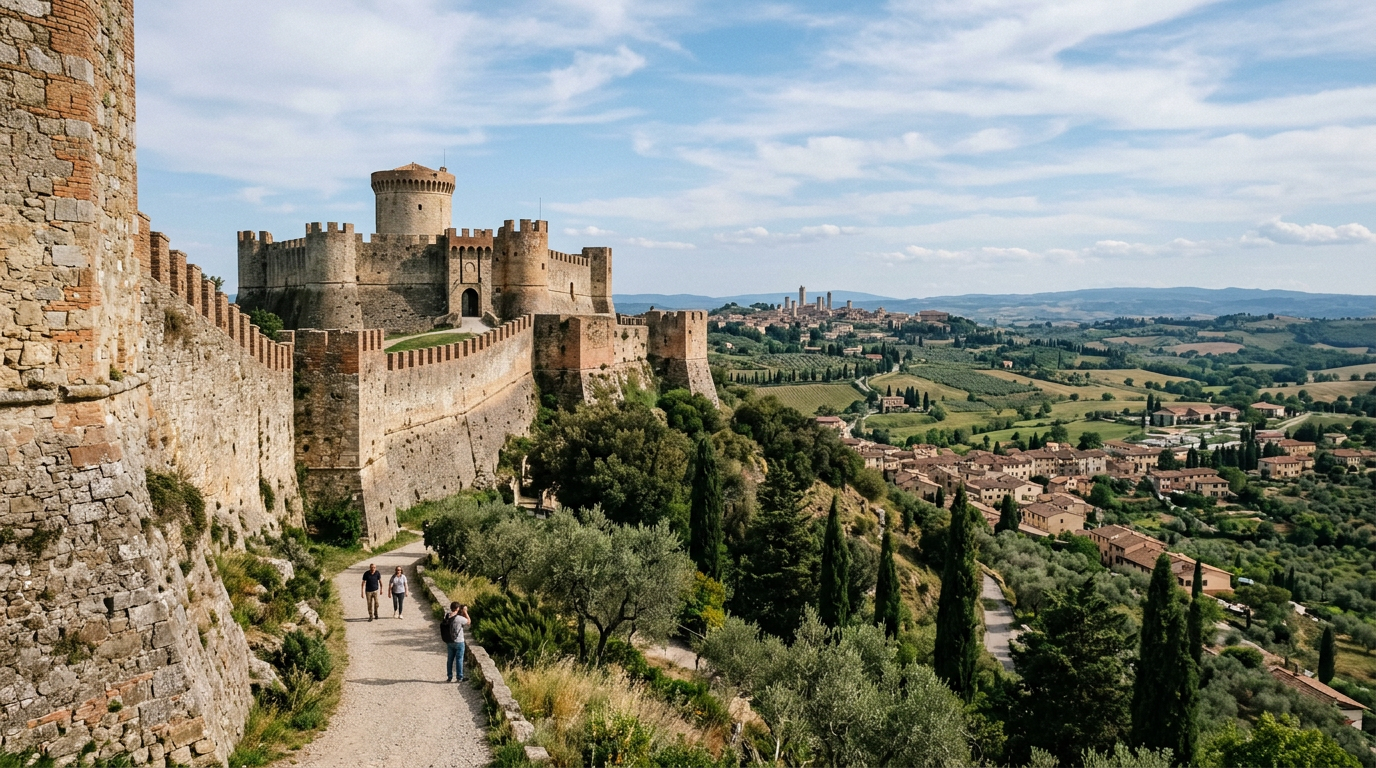
Poggibonsi: hidden sights and practical tips
Poggibonsi is not on anyone’s list of the must-see towns of Tuscany. It has no famous towers, no perfectly preserved medieval piazza, no literary associations with writers taught in schools across the world. What it has instead is more useful in a different way: a real Tuscan town functioning at its own pace, a Medici fortress on the hill above it that tells a fascinating story, an archaeological museum of genuine quality, and a weekly market that serves the people who live here rather than the people who visit.
For anyone staying near Barberino Val d’Elsa, Poggibonsi is the closest substantial town — 12 km away and around 15 minutes by car on the SR2. It provides practical services (supermarkets, pharmacies, hardware shops, a good selection of cafes) and a handful of sights that reward the drive even on days when the primary goal is simply running errands.
Poggibonsi what to do and see
The history of Poggibonsi explains why it looks the way it does today. In the medieval period it was a significant comune with commercial importance and territorial ambitions. Its position at a natural crossing point in the Val d’Elsa made it strategically valuable, and for much of the 13th century it competed for influence with both Florence and Siena. The decision to shift alliances one too many times proved fatal. In 1270, Florence and Siena acted together and destroyed the medieval commune.
The town that rebuilt itself after 1270 was a humbler place, rebuilt further down the valley from the original site. The current layout of Poggibonsi is essentially post-medieval. There is no historic centre of the type you find in Barberino Val d’Elsa or Colle Val d’Elsa. What there is instead are a Medici fortress on the ridge above, a collection of archaeological finds that document the territory’s longer history, and the ordinary dignity of a town that has never particularly tried to be picturesque.
The best approach is to begin with the fortress — the views from its walls give you the geography of the area — then descend to the Archaeological Museum in the late morning, and finish with a walk through the market if your visit coincides with Thursday or Saturday.
The Medici Fortress of Poggio Imperiale
The Rocca di Poggio Imperiale dominates the hill above Poggibonsi. It was commissioned by Lorenzo de’ Medici in 1488, just four years before his death, to designs by Giuliano da Sangallo. The architect was one of the leading military engineers and architects of the late 15th century, responsible for several other Florentine fortifications as well as civil buildings in and around Florence.
The fortress was intended as more than a defensive structure. Lorenzo planned to build a new Florentine city on this hill — a Medici città di fondazione in the heart of the Val d’Elsa, demonstrating the family’s reach and ambition in the territory between Florence and Siena. A planned settlement was laid out alongside the fortress. Some of the foundations of this planned urban development are visible today.
The project was abandoned almost immediately after construction began. Lorenzo died in 1492. The French invasion of Italy under Charles VIII followed in 1494, fundamentally disrupting the political situation that had motivated the building. The fortress was never completed. What survives is a substantial fragment: sections of the polygonal defensive walls, the main gateway, and the footprint of the planned buildings inside.
Since the 1990s, the site has been the subject of systematic archaeological investigation. The ongoing excavations have revealed the foundations of the planned Medici settlement in considerable detail, and the site is open to visitors who can follow the investigation in progress.
The fortress can be visited independently or with a guide. A small entrance fee covers the walls, the gateway, and the archaeological areas. The views from the surviving wall sections extend over the entire Val d’Elsa and across to the Chianti hills — some of the most extensive in the area.
Archaeological Museum
The Museo Archeologico del Chianti Senese is housed in the Palazzo Pretorio on the main square of Poggibonsi. It is a serious museum covering the territory from the Bronze Age to the end of the medieval period, and it is considerably better than the size of the town might lead you to expect.
The strongest sections deal with the Etruscan and Roman periods. The Val d’Elsa valley was densely populated during these eras — the natural route along the river valley made it an important communication corridor long before the Romans formalised it as a road. The museum holds finds from excavations at La Rocca di Staggia and from Etruscan tombs throughout the surrounding territory. Ceramics, metalwork, and personal objects recovered from burial sites give a detailed picture of daily life in this valley two and a half thousand years ago.
The Roman section documents the transition from Etruscan to Roman settlement, including the gradual reorganisation of the landscape under Roman agricultural management. The medieval section brings the story forward, covering the development of Poggibonsi and surrounding settlements from the early medieval period through the communal age that preceded the 1270 destruction.
The museum is contained enough to visit in 90 minutes without feeling rushed. The display is clearly organised and well maintained. Entry is affordable. It is a good choice for a morning visit before the heat of a summer afternoon, or as a primary destination on a cooler day.
Weekly markets
The main weekly market in Poggibonsi takes place on Thursday morning. It is one of the largest markets in the Val d’Elsa in terms of both scale and variety. The market occupies a substantial area in the central part of town and runs until early afternoon.
The Thursday market is emphatically a local rather than a tourist market. The stalls cover clothing, household goods, tools, and a significant food section where local producers sell seasonal vegetables, salumi, cheese, fresh bread, and eggs. Prices are those a local resident would pay, not those adjusted for visitors. The atmosphere is functional and good-humoured.
A smaller Saturday market focuses almost entirely on food. It is a more considered option for buying seasonal produce, local cheese, and farm goods. This is the kind of market where you discover what is actually in season in the local countryside at the time of your visit: freshly dug artichokes, bunches of cavolo nero, handmade pasta, jars of wild boar ragù.
Both markets finish by early afternoon, typically around 13:00. The best selection is available before 11:00, when the food stalls are well stocked and the atmosphere is at its most animated.
How to get there from Barberino Val d’Elsa
Poggibonsi is 12 km from Barberino Val d’Elsa. The most direct route follows the SR2 south-east from Barberino, which takes approximately 15 minutes. There is also a parallel secondary road through the valley floor that is slightly longer but avoids the main road traffic.
The train is a practical alternative. The Empoli-Siena line stops at both Barberino Val d’Elsa and Poggibonsi-San Gimignano stations. The journey between the two takes about 10 minutes and runs several times a day. This is the most convenient option for a visit focused on the market or the museum, where you would prefer to avoid parking in the town centre.
Cycling between Barberino and Poggibonsi via the valley road is a flat 12 km that takes 40 to 50 minutes on a standard bicycle. The route follows the valley floor and is not particularly scenic, but it is practical and low in traffic for most of its length.
Parking in Poggibonsi is generally available near the archaeological museum, in the lower areas near the railway station, and in the car parks at the base of the hill leading up to the fortress. On Thursday mornings, street parking near the market is harder to find and it is better to park further from the centre and walk.
Where to stay
Sogno d’Oro is in Barberino Val d’Elsa, 15 minutes from Poggibonsi by car. The proximity to a functioning town with complete services is one of the practical advantages of staying in this part of the Val d’Elsa — everything from a hardware shop to a well-stocked supermarket is closer than you might expect from a rural base.
The Medici Fortress alone is worth an afternoon visit. Combined with the Archaeological Museum and a morning market, Poggibonsi makes for a genuinely interesting and unhurried half-day.