Monticchiello: what to see in this medieval gem of the Val d'Orcia
Monticchiello stands on a ridge in the southernmost corner of the Val d’Orcia, at about 520 metres above sea level. The village looks out over a landscape that was inscribed as a UNESCO World Heritage Site in 2004, and for good reason: from the walls you see the cypress-lined roads, the pale clay hills, and the distant profile of Monte Amiata in a single, unhurried view. The community numbers around two hundred permanent residents. It is among the smallest inhabited walled villages in Tuscany, and among the most quietly compelling.
From Barberino Val d’Elsa the drive south takes about 70 km and roughly 60 minutes. The route follows the SR2 Cassia through Siena, then continues toward Torrenieri, where you turn east toward Pienza and then south toward Monticchiello. It is a drive through varied and beautiful Tuscan terrain that already gives you an appetite for the destination.
Monticchiello: the intact village
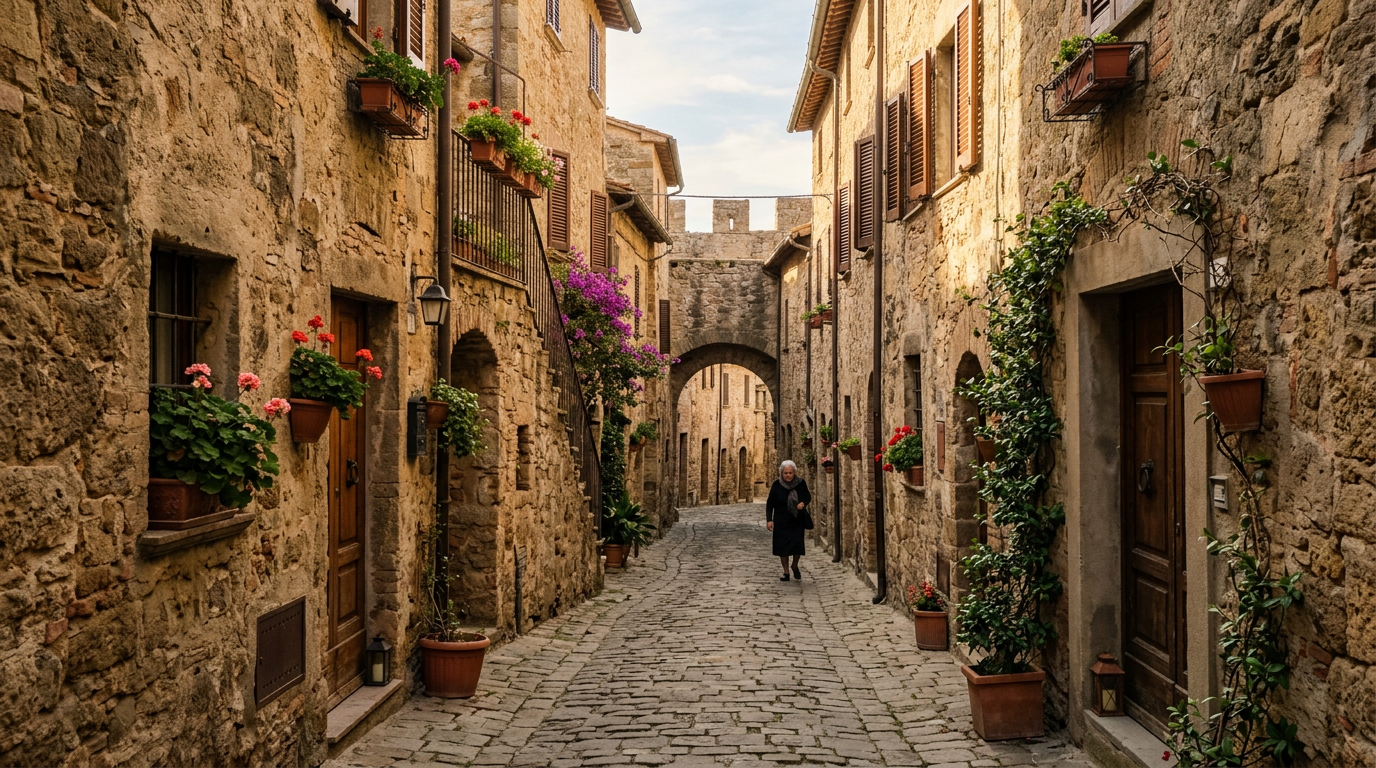
Step through the Porta Nova and the medieval world closes around you. The main gate, built in the 13th century, opens directly onto a stone-paved lane flanked by houses of warm grey travertine. There are no shops selling souvenirs, no restaurants advertising tourist menus with photographs. What you find instead is a working village with a fully intact circuit of medieval walls, a character formed over eight centuries, and a quiet that is increasingly rare in Tuscany.
The church of Santi Leonardo e Cristoforo stands at the highest point of the village. Its interior is plain and cool, with a stone floor worn smooth over centuries. A fresco on the inside wall has been attributed to Pietro Lorenzetti, a Sienese master active in the first half of the 14th century. Whether the attribution is entirely correct or not, the quality of the painting is evident. It is devotional art made for a small community, not for a cathedral.
The alleyways between the main street and the walls are barely wide enough for two people to pass. Stone arches connect buildings overhead. At the edges of the village, gaps between houses frame sudden views over the valley below. The whole experience of moving through Monticchiello is intimate and unhurried.
The village receives far fewer visitors than Pienza or Montepulciano, both of which are visible on clear days from the walls. That relative obscurity is what makes it so valuable to anyone who visits. You are not competing with crowds for the view or the table.
The Teatro Povero di Monticchiello
Monticchiello’s most extraordinary feature is not architectural. It is a community theatre company, founded in 1967, that creates and performs a new original play every summer. The Teatro Povero, which translates literally as Poor Theatre, takes the name from the idea that theatre does not require costumes, professional actors, or elaborate sets. What it requires is a living community with something to say.
Each year, the villagers themselves write and perform the production collectively. The process begins in winter with community discussions about a theme. Rehearsals run through spring. By July the play is ready and performed several times a week in the village square, with the medieval walls and the open landscape of the Val d’Orcia as the backdrop.
The actors are farmers, shopkeepers, students, and retirees. They are not trained performers, and that is part of the point. The plays address real subjects: the disappearance of traditional farming culture, the tension between preservation and change, the effects of mass tourism on small communities, and the experience of living in a place that the outside world treats as a postcard rather than a home.
Performances run through July and into early August. Tickets are issued in limited numbers and sell out well before the season opens. If attending is part of your plan, check the official Teatro Povero website in June when the programme is published and book immediately.
Attending a performance connects you to Monticchiello in a way that walking the walls alone does not. You are briefly part of the village’s own story.
The view over Val d’Orcia
The northern wall of Monticchiello offers one of the most open and least crowded panoramic views in all of the Val d’Orcia. A section of walkable parapet faces directly toward Pienza, nine kilometres to the north-northwest. On a clear day you can see the cathedral and palace of Pius II rising above the village. To the right, the outline of the Sienese hills stretches north. Below, the patchwork of wheat fields, vineyards, and cypress avenues is exactly as it appears in Renaissance paintings, because the landscape has changed very little in five centuries.
In autumn, from October onward, the light turns the clay hills golden in the late afternoon. The colours are saturated in a way that is unusual even for Tuscany. Photographers often stay at the wall for an hour or more as the sun drops. In spring the same view is green, soft, and dotted with wildflowers along the tracks below the walls.
The viewpoint is always open and always free. There is nothing to buy and nothing to queue for. You simply walk to the northern side of the village and look.
Where to eat in the village
Monticchiello has one serious restaurant within the walls: Osteria La Porta. It has been the standard-bearer for local cooking here for many years, with a kitchen that changes the menu according to the season and what the surrounding land is producing. Typical dishes include pici all’aglione, which is hand-rolled pasta with a simple sauce of garlic, tomatoes, and olive oil; ribollita in winter; grilled Cinta Senese pork when available; and a wine list focused on the great names of the southern Val d’Orcia, including Brunello di Montalcino and Vino Nobile di Montepulciano.
Reservations are strongly recommended, particularly on weekends and during the theatre season when the village receives more visitors. The restaurant is small and the best tables go quickly.
Near the main gate there is a small bar where you can get an espresso, a cold drink, and a simple snack. For a picnic, buy provisions in Pienza before arriving. Pienza is nine kilometres north and has excellent pecorino, local bread, and cured meats available from the alimentari and the small shops along the main street.
How to get there from Barberino Val d’Elsa
The drive south from Barberino follows the SR2 Cassia toward Siena. From Siena take the ring road and continue south on the SR2 toward Buonconvento. At Torrenieri, turn east on the road toward Montepulciano. Pass through Pienza and take the secondary road south, following signs for Monticchiello over seven kilometres of open farmland.
The total distance is about 70 km. Allow 60 minutes without stops. The approach road from Pienza climbs gently through open fields and is itself beautiful.
Parking is outside the village walls in a small free car park directly below the Porta Nova. On summer weekends the lot fills by mid-morning. Arriving before nine or after six helps.
Where to stay
Sogno d’Oro in Barberino Val d’Elsa is just over an hour from Monticchiello by car, placing the entire southern Val d’Orcia within comfortable day-trip range. You can leave after breakfast, spend a full day in and around the village, and return in the evening to the quieter world of the Chianti hills.
Using Barberino as a base gives you flexibility that staying in Pienza or Montalcino itself does not. You are close enough to the Val d’Orcia to go whenever the weather and light are right, without committing your itinerary around a single destination.