Montalcino Brunello winery visit: a guide for first-time visitors
A visit to a Brunello di Montalcino winery is a different experience from most Tuscan wine tastings. The wine itself demands it. Brunello is not a wine you drink casually on a Tuesday afternoon. It is a wine that takes five years or more to reach the bottle, that continues developing for decades, and that — when you taste it at the estate where it was made — gives you a sense of time and place that most wines cannot approach.
Montalcino is about 70 km from Barberino Val d’Elsa. The drive takes roughly 60 minutes on the SR2 through Siena. You can make it a focused day trip. You can also build it into a longer journey south through the Val d’Orcia, stopping at Pienza or San Quirico d’Orcia on the way.
Montalcino and Brunello
Brunello di Montalcino is made exclusively from Sangiovese Grosso, a local clone known in Montalcino simply as Brunello. The grape is late-ripening, high in acidity and tannin, and produces wines with a natural structural framework that ages gracefully over very long periods.
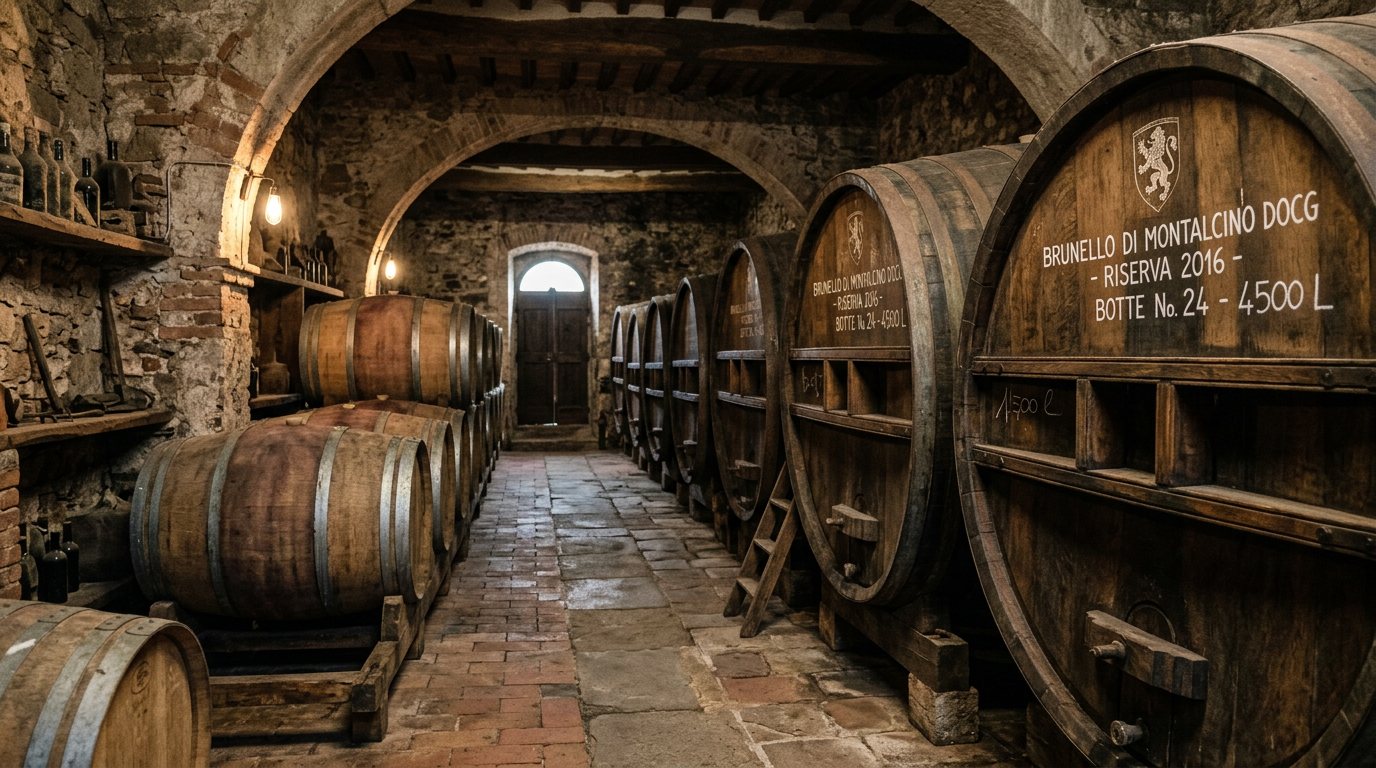
The DOCG regulations require a minimum ageing of five years from harvest before the wine reaches the market — two of those years in oak barrels and four months in bottle. The Riserva category requires six years total. These rules are among the most demanding of any Italian denomination and are the reason Brunello commands the prices it does.
The town of Montalcino sits on a hilltop at about 570 metres above sea level. The 14th-century Rocca fortress at the southern end of the town is visible from a great distance. Inside the fortress is an enoteca selling wines from dozens of local producers — a good first stop if you want to orient yourself before committing to a cellar visit.
The Rosso di Montalcino, produced from the same grape but with shorter ageing (one year), offers an accessible introduction to the territory. Tasting the Rosso alongside a Brunello from the same estate shows you how time in barrel and bottle transforms the same raw material.
Wineries to visit
The Montalcino area has more than 200 producers. The quality range is wide. A short list of reliable choices for different visitor types:
Biondi-Santi at the Greppo estate is where Brunello as a wine category began. Ferruccio Biondi-Santi developed the formula in the late 19th century, and the estate has maintained an unbroken commitment to the original vision. Visits require booking well in advance and cost 50 euros or more per person. If Italian wine history matters to you, this is a visit of genuine significance.
Casanova di Neri, in the Cerretalto area south-east of Montalcino, produces some of the most concentrated and long-lived Brunellos in the denomination. The estate farms conventionally but with meticulous attention to the vineyard. Visits by appointment.
Poggio di Sotto, now part of a larger group but retaining its original approach, makes wines of extraordinary precision and mineral clarity. The Rosso di Montalcino here is one of the best arguments for that category as a serious wine rather than a simpler alternative to Brunello.
For first-time visitors who want a more welcoming and less intimidating entry point, the estates in the Sant’Angelo in Colle area south of the town tend to be smaller, more personal, and easier to approach. This zone produces wines with slightly riper fruit character than the cooler slopes directly below the town.
How to book a tasting
Advance booking is essential for most Montalcino producers. Walk-in visits to serious cellar estates are rarely possible, particularly during the busy months of April through October.
The most efficient approach is direct email contact. Write to two or three estates a week before your intended visit. Include the date, the number of people in your group, and a sentence about your interest in Brunello. Most producers respond within 24 to 48 hours. Outside high season, a week’s notice is usually enough.
A standard visit at a small or medium estate lasts 60 to 90 minutes. It typically includes a tour of the production area — the fermentation tanks, the barrel rooms, the ageing cellar — followed by a tasting of three to five wines. Prices range from 20 to 50 euros per person depending on the producer and the wines included.
Some estates offer extended tastings with food pairings — local salumi, bread, aged pecorino — alongside the wine. These run 60 to 90 euros per person and are worth the cost if you want the tasting to function as a full early-afternoon experience rather than a brief educational stop.
If you prefer not to drive between estates, taxis from Montalcino to nearby farms cost around 15 to 20 euros each way. This removes the designated-driver problem and allows both people in a couple to taste fully.
Brunello di Montalcino: characteristics
Knowing a few things about the wine helps you get more from any tasting.
Young Brunello — a release from the most recent year on the market — tends to be tight and austere. The tannins are present and firm. The acidity is high. The fruit is concentrated but not immediately expressive. This is not a flaw. It is the structural reality of a wine designed to be aged, not drunk immediately.
Aromas in young bottles lean toward red cherry, dried flowers, tobacco, and mineral notes. With four to eight years of bottle age, the wine opens into dried fruit, leather, liquorice, and an earthy complexity that younger bottles do not show. At 15 or more years, the best Brunellos develop tertiary aromas — truffle, dried herbs, preserved fruit — that represent one of the most distinctive flavour experiences in Italian wine.
The most critically acclaimed recent vintages are 2010, 2012, 2015, and 2016. Ask your host which vintages they currently have available and which they feel best represent the character of their estate. Each producer has views on this that are worth listening to.
Serve Brunello at 18 degrees Celsius in a large Burgundy-style glass. Open the bottle 45 to 60 minutes before drinking. If you are tasting at a winery on a warm day, the cellar temperature may be ideal — if you are taking wine back to your accommodation, give it time to adjust.
Rosso di Montalcino, the entry wine from the same grape, is best at around 16 degrees and does not require extended opening time. A useful comparison: taste the Rosso first, then the Brunello. The difference tells you what five years of ageing under strict denomination rules actually does.
How to get there from Barberino Val d’Elsa
The direct route goes south on the SR2 through Poggibonsi and Siena. From the Siena ring road continue south on the SR2 Cassia toward Buonconvento. After Buonconvento follow signs for Montalcino. The final section climbs through vineyards and olive groves before arriving at the town walls.
Total distance: approximately 70 km. Drive time: approximately 60 minutes without traffic.
A slightly longer but more scenic route goes through Pienza and the Val d’Orcia on the SP146, adding about 15 minutes but passing through one of the most beautiful landscapes in central Italy.
Parking is available outside the town walls. The historic centre is restricted to residents. Park near Porta Burelli or Piazza Cavour and walk in. The town is compact and fully explorable on foot in two hours.
Fill the tank before leaving Barberino. Petrol stations on the SR2 through the Crete Senesi south of Siena are infrequent.
Where to stay
Sogno d’Oro in Barberino Val d’Elsa is 70 km and 60 minutes from Montalcino. Leave after breakfast, visit a winery before or after lunch, explore the Fortezza enoteca, and return in the evening with a bottle of Brunello chosen at the cellar door. The drive back through the Crete Senesi in the late afternoon light is one of the better endings to a day in Tuscany.