Empoli day trip from Barberino Val d'Elsa: museums, lunch, and the real Arno valley
Empoli sits in the lower Arno valley, about 30 kilometres southwest of Florence and 25 kilometres from Barberino Val d’Elsa. It is a town of around 50,000 people with a real working identity: manufacturing, food production, trade. Unlike the hilltowns that dominate Tuscany’s tourist map, Empoli has never tried to project a curated image of itself to visitors. That is, unexpectedly, one of its greatest qualities.
Visiting Empoli from Barberino Val d’Elsa takes 25 minutes by car or around 20 minutes by the regional train that runs between Siena and Empoli. The town rewards a half-day focused on its museums and medieval centre, or a full day if you want to add a slower lunch, a market visit, and time to walk without a schedule.
Empoli on a day trip from Barberino
The first thing to understand about Empoli is that it is not a destination you come to for atmosphere alone. The street life is Italian in the most ordinary sense: people buying bread, sitting at bar counters, pushing bicycles through the shopping street. There is no performance of Tuscan charm here, which is precisely what makes a visit feel different from the standard regional circuit.
What Empoli does have, and what justifies the short drive from Barberino, is a pair of cultural institutions that are genuinely exceptional in quality relative to the size of the town. The Museo della Collegiata holds Early Renaissance paintings that would be headline works in a major city museum. The Museo del Vetro documents a centuries-old local glass tradition with intelligence and clarity. Together they take three to four hours and leave you with a very different picture of Tuscany than the one you arrived with.
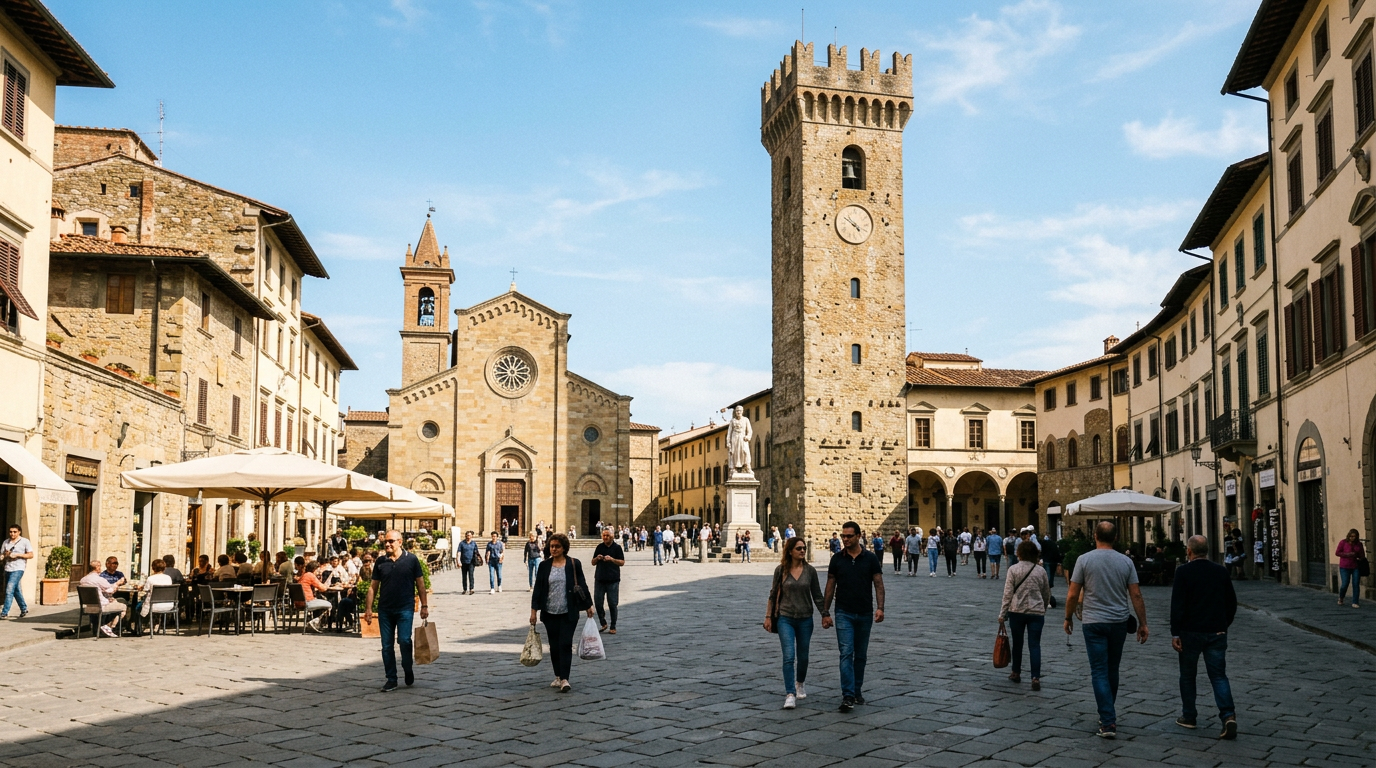
The central square, Piazza Farinata degli Uberti, is the social and historical core of the town. Arrive by nine-thirty and start there. The Collegiate Church on the square is usually open from early morning. The museums open at ten. A good plan is church and square in the early morning, the Museo della Collegiata before lunch, lunch in the centre, and the Glass Museum in the early afternoon.
The Glass Museum and the Collegiate Church
The Museo del Vetro di Empoli is installed in the former Augustinian convent of Santo Stefano, a building that sits a short walk from the central piazza. The museum exists because Empoli was, from the medieval period through most of the twentieth century, one of the principal centres of glass production in Italy. The most famous product was the fiasco: the bulbous, straw-wrapped glass flask that became the international symbol of Chianti wine from the eighteenth century onward. Empoli’s glassworkers produced millions of these flasks at their peak output.
The museum traces this history through production tools, archival photographs, finished examples from different periods, and contemporary works by glassmakers continuing the tradition. It is not a large museum and the subject matter is very specific, but it is presented with enough context and visual interest to hold attention for an hour without difficulty. If you arrive in a group, the staff are often available to explain specific pieces in some detail.
The Collegiata di Sant’Andrea stands in the centre of Piazza Farinata degli Uberti. The facade is Romanesque, decorated with the alternating green and white marble bands characteristic of Pisan influence that spread across much of Tuscany in the twelfth and thirteenth centuries. It is one of the most recognisable facades in the Arno valley and looks best in early morning or late afternoon light when the contrast of the marble is sharpest.
The Museo della Collegiata, attached to the church and entered through a separate door, is the most significant cultural institution in Empoli. Its collection of Early Renaissance paintings is remarkable by any standard. Works by Filippo Lippi, Lorenzo Monaco, Masolino da Panicale, and Jacopo Pontormo are among the highlights. The painted Pietà completed by Masolino in 1424 is the centrepiece: a large-format devotional image of high technical quality painted for a church in the area and preserved here ever since. The light in the museum is controlled, the rooms are rarely crowded, and the chance to spend unhurried time in front of major works is real.
The historic centre on foot
Walking the historic centre of Empoli requires only about 90 minutes if you move with some purpose. The area of interest is bounded roughly by the central piazza to the south, the Arno riverfront to the north, and the ring of nineteenth-century streets that replaced the old walls to east and west.
The medieval character of the town is most visible in the streets immediately around the Collegiate and in the area between the piazza and the river. The Palazzo Ghibellino, associated with the infamous Ghibelline assembly of 1260 held in Empoli following the Florentine defeat at Montaperti, stands near the central square. The building visible today is largely from later periods, but the historical resonance of the site is significant: it was here that the Ghibelline leaders considered and ultimately rejected a proposal to raze Florence entirely.
The covered market hall, a few streets north of the piazza, is a practical and pleasant destination. It operates on weekday mornings and sells fresh produce, local cheese, bread, and salumi. The mix of stalls and the ordinary Italian food-shopping atmosphere inside make it a worthwhile 20-minute stop.
The Arno riverfront at Empoli does not have the dramatic setting of Florence or Pisa, but a walk along the embankment gives a different perspective on the town’s relationship with the river that defined its economic history.
Where to have lunch in Empoli
Empoli is a good town for an honest Tuscan lunch at local prices. The trattorias and osterie around the central piazza and in the streets north of it cater primarily to working residents rather than tourists. This shows in the prices and in the quality of the food.
A full three-course lunch with a carafe of local wine typically costs between 20 and 30 euros per person. Menus follow the standard Tuscan structure: antipasto misto with bruschetta, cured meats and cheese, then a first course of pasta, followed by a meat or fish second course. The pasta is almost always made fresh on the premises.
The bar culture in Empoli is worth participating in. The standing espresso at a counter costs around one euro and the cornetti — the Italian breakfast pastry — are made locally and noticeably better than the packaged versions you find elsewhere. Have a coffee at the counter and watch the morning traffic of the piazza before heading to the first museum.
How to get there from Barberino Val d’Elsa
By car, the drive from Barberino Val d’Elsa to Empoli takes about 25 minutes. The route goes north through Certaldo and then northwest toward Empoli on the main Arno valley road. The distance is approximately 25 kilometres.
By train, the Siena-Empoli regional line stops at Barberino Val d’Elsa station. From there, Empoli is about 20 minutes away with several services per day in each direction. The station in Empoli is about 10 minutes on foot from the historic centre and the main square. Taking the train is a practical alternative that avoids parking entirely.
Parking in Empoli is available in paid and free car parks around the outer edge of the historic centre. The areas near the train station and the hospital have accessible paid parking. In the town centre itself, the central streets are restricted for most of the day to residents and deliveries.
Where to stay
Sogno d’Oro guesthouse in Barberino Val d’Elsa is 25 minutes from Empoli by car and a similar time by train. This makes Empoli one of the easiest and most low-effort cultural excursions available from the guesthouse. You can leave after breakfast, spend a morning at the museums, have lunch in town, and return in the early afternoon to explore the Val d’Elsa countryside or simply rest.