Tuscan wine tasting: how to plan the perfect winery visit
Tuscany makes wine in a way that invites visitors to participate in the process rather than simply consume the result. The wineries here are not factories behind corporate reception desks. Many of them are family homes where the same people who plant the vines, pick the grapes, and make the decisions are also the ones who pour the wine and explain what you are tasting.
If you are staying near Barberino Val d’Elsa, you are positioned with unusual precision in the middle of this experience. The Chianti Classico DOCG zone surrounds you on the eastern and southern sides. Vernaccia di San Gimignano is 28 km to the west. Brunello di Montalcino and Vino Nobile di Montepulciano are within a 90-minute drive to the south. You could taste a different major Tuscan wine denomination each day for a week and never drive more than an hour.
Wine tasting in Tuscany
Tuscan wine culture has always been open to the curious outsider. Unlike some old-world wine regions where visits require professional credentials or institutional introductions, the estates of Chianti Classico have welcomed individual travellers for decades. The understanding is simple: wine is made to be drunk and shared, and the people who make it generally like talking about it.
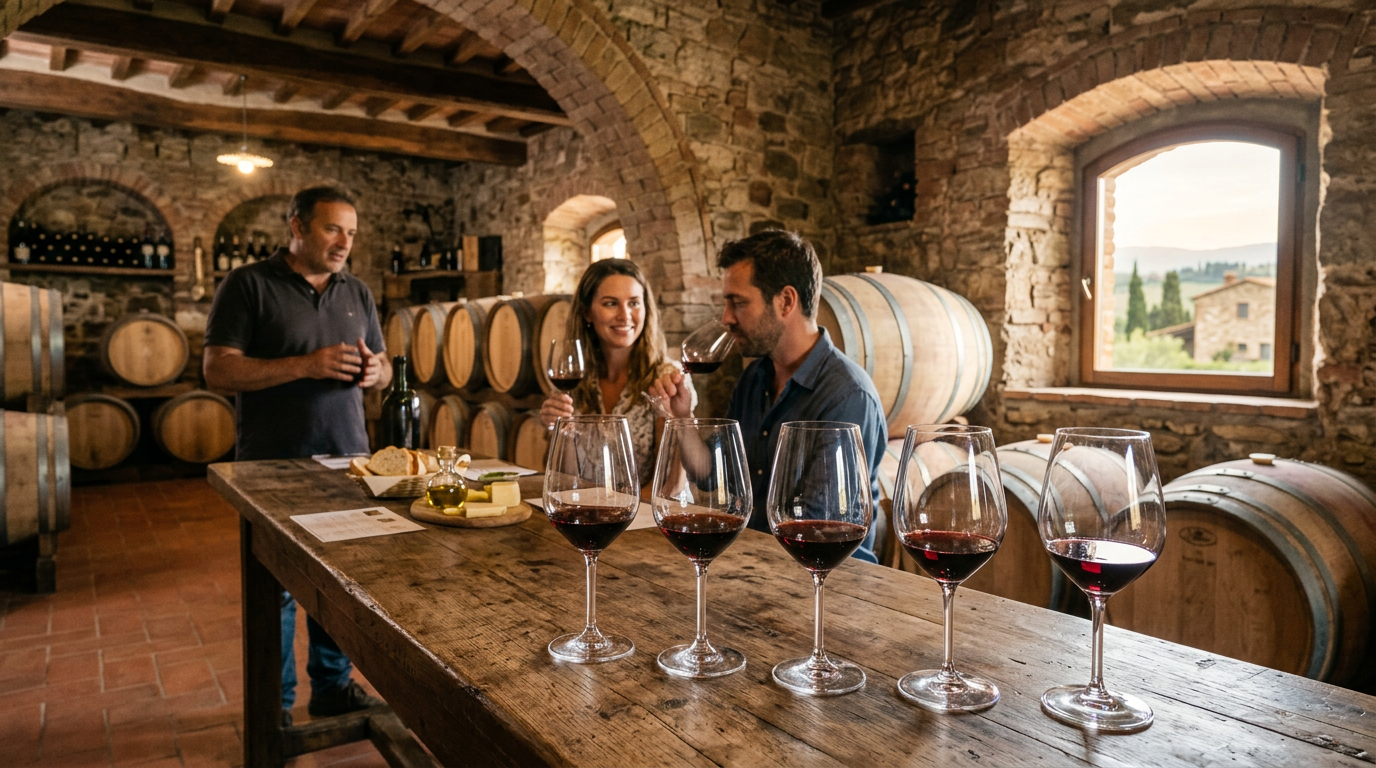
A standard tasting at a Tuscan estate lasts between 45 and 90 minutes. It usually begins with a brief tour of the vineyards or the cellar — sometimes both. Your host will explain the grape varieties they grow, the composition of the soil, how they manage the vines, and what the most recent vintages have been like. This context is not preamble. It is essential information that changes how you taste the wine that follows.
Booking in advance is strongly recommended and, for the most prestigious estates, is mandatory. Most wineries handle bookings by email. Include your preferred date, the number of people in your group, and whether you have any dietary restrictions if food is part of the tasting. Two weeks’ notice is usually enough outside of July and August. During high season, book three to four weeks ahead.
Prices in the Chianti Classico zone range from around 15 euros per person for a straightforward three-wine tasting to 50 euros or more at estates that pour barrel samples, library vintages, or food pairings. The higher-priced tastings are usually worth the cost if you have a genuine interest in understanding the wine at depth.
How a tasting is organised
Arriving at a Tuscan estate, the first thing you notice is the scale of the place. Small family estates may have a total of 8 to 15 hectares of vines. The cellar might be a single room with a few dozen barrels, a bottling line in the corner, and a table set up with clean glasses. Medium estates have dedicated tasting rooms, barrel halls, and sometimes landscaped terraces with views over the vineyards.
Your host — the winemaker, a family member, or a dedicated tasting guide — will take you into the production area. The fermentation tanks, typically stainless steel or concrete, hold the wine in its early weeks. The barrel room, cooler and darker, is where the wine spends one to three years developing structure and complexity in oak. At a good estate, the host explains not just what you are looking at but why specific choices were made: why these barrels rather than those, why this vineyard block makes a separate wine, why harvest was earlier or later this year than last.
The tasting itself happens in whatever space the estate uses for visitors. Some producers pour outdoors under vines. Others use formal tasting rooms. Others simply clear a corner of the barrel cellar and set out glasses on a cask. The quality of the experience is rarely related to the elegance of the setting.
You are expected to engage. Ask why a particular wine tastes different from the one before it. Ask about the vintage. Ask what the wine will taste like in five years. Ask what the producer drinks at home. These questions are not impertinent. They are the point of being there.
At the end, there is no obligation to buy. But buying at least one bottle is a natural and courteous response to a hour or more of someone’s time and attention.
Wine areas near Barberino
Three wine zones are within 30 minutes of Barberino Val d’Elsa.
Chianti Classico is the closest. The DOCG boundary begins at the eastern edge of the Val d’Elsa. Estates in San Donato in Poggio, Tavarnelle, and on the Barberino side of the hills are reachable in 10 to 15 minutes. The main Chianti towns — Panzano, Castellina, Greve, Radda, Gaiole — extend the zone eastward and southward and are 25 to 40 minutes from the guesthouse.
Vernaccia di San Gimignano is about 28 km west. The white wine produced on the sandy soils around San Gimignano has been documented since the 13th century and holds the distinction of being Italy’s first DOC wine. The estates here are compact, the wines are elegant and age-worthy in their Riserva form, and the town itself is worth half a day.
Colli dell’Etruria Centrale is a broad DOC that covers much of the Val d’Elsa and neighbouring areas. Wines here are varied in style and quality, but good producers work throughout the zone and are often the easiest to visit informally without advance booking.
Within an hour’s drive to the south and south-east, you can add Brunello di Montalcino, Vino Nobile di Montepulciano, and Morellino di Scansano to your itinerary. Each of these represents a distinct expression of Sangiovese in a different landscape and at a different altitude.
Wineries that accept walk-in visits
Most serious Chianti Classico estates require advance booking. But several options exist for visitors who prefer spontaneity.
Rocca delle Macie near Castellina in Chianti operates a large, well-run visitor facility that is generally accessible to walk-in guests. Tastings start at around 15 euros. The estate is one of the larger Chianti Classico producers and the tasting experience is professional and informative.
The enoteca inside the Fortezza di Montalcino is a reliable option for spontaneous tastings of Brunello and Rosso di Montalcino from a wide selection of producers. A flight of three wines starts at around 12 euros. No booking required and no pretension.
The Enoteca del Chianti Classico in Greve in Chianti, on Piazza Matteotti, serves wines by the glass from dozens of local producers. This is not a winery visit but it is an excellent way to taste and compare before deciding which estates to book formally.
Several estates in the Barberino and Tavarnelle area operate cellar-door sales with informal tastings. Look for “vendita diretta” (direct sales) or “degustazione” signs on the local roads. These producers are happy to have visitors without prior arrangement, particularly outside the main summer months.
What to taste and how
For a first Chianti Classico tasting, ask to compare a standard Annata and a Riserva from the same producer. The Annata is typically released about two years after harvest and offers freshness and direct fruit character. The Riserva, aged longer in barrel and bottle, develops more complexity — secondary aromas of leather, dried flowers, tobacco, and a longer, more savoury finish.
When tasting, begin with the colour. Pour the wine against a white background and look at the rim. In young Sangiovese the rim is bright red with a slight orange tint even in the first year. As the wine ages the orange deepens toward garnet and eventually tawny. A very purple, deeply coloured Chianti Classico may have been made with some added international varieties, which is not necessarily wrong but worth knowing.
Swirl the glass to release the aromas, then nose it in two stages: a quick, light sniff first to get the primary impression, then a deeper inhalation. Typical young Chianti Classico aromas are red cherry, dried herbs, light earthiness, and a faint mineral quality. With age these evolve toward dried fruit, leather, tobacco, and savoury complexity.
In the mouth, notice the acidity — Sangiovese is a naturally high-acid grape, and this is a feature rather than a flaw. The tannins, particularly in a Riserva, may be firm. A long finish — meaning the flavour impression persists well after you swallow — is one of the clearest markers of quality.
Where to stay
Sogno d’Oro in Barberino Val d’Elsa sits in the countryside that produces the wines described here. You can taste the wine, walk back through the vineyards, and have dinner with a glass of what you tasted that morning. Whether you plan a structured multi-day wine itinerary or simply decide on a tasting at breakfast and drive out after coffee, the guesthouse puts you in exactly the right place.