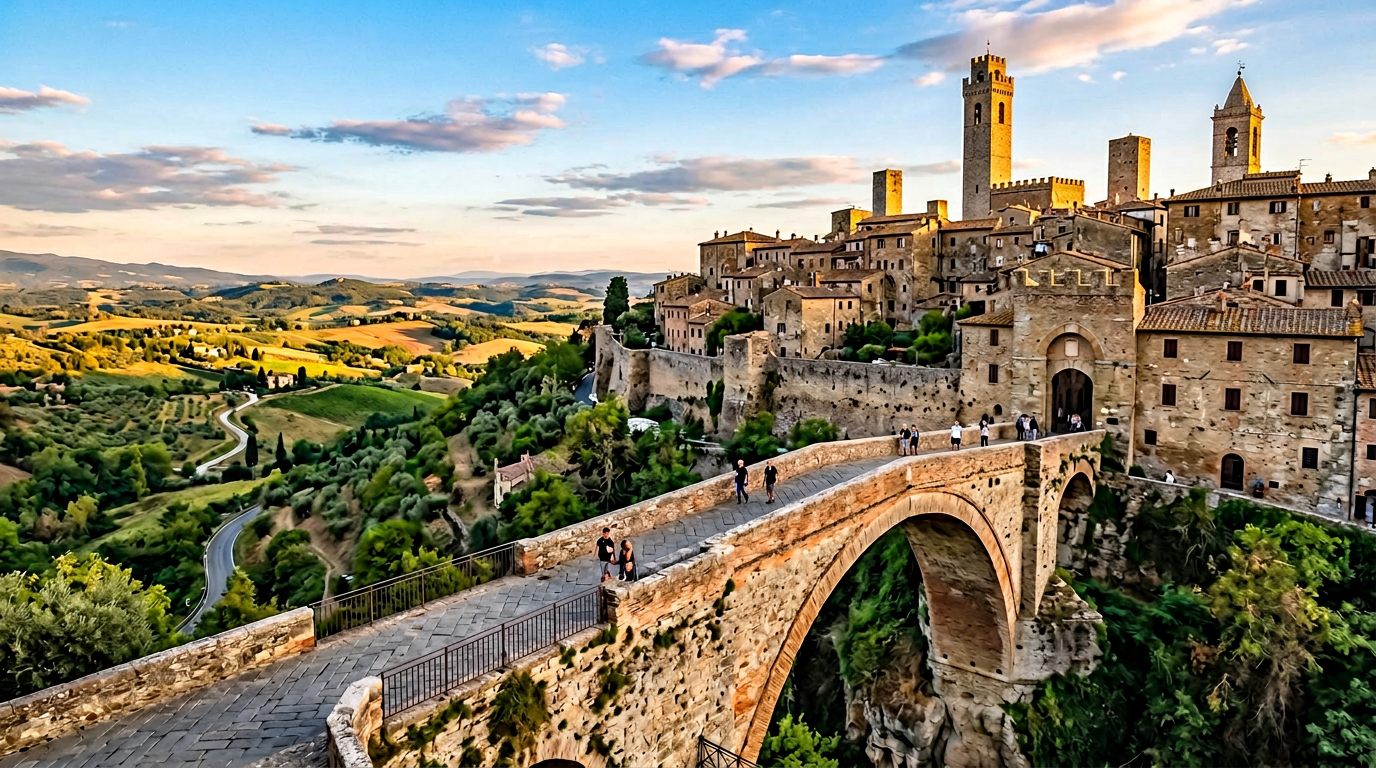
Colle Val d'Elsa: guide to the medieval upper town
Colle Val d’Elsa is the largest town in the Val d’Elsa with a population of around 22,000. The lower modern town, Colle Bassa, sits in the valley and serves as a functional commercial centre. The upper medieval district, Colle Alta, occupies a narrow ridge above — a completely different world of towers, Gothic architecture, and valley views. The two parts of the city are linked by a road and a steep pedestrian path, and the contrast between them is one of the most instructive things about Colle Val d’Elsa: the medieval ridge is perfectly preserved because the town never stopped growing below it.
It is about 18 km from Barberino Val d’Elsa and 20 minutes by car on the SR2. A half-day is sufficient for the main sights. A full day allows for the Crystal Museum, a proper lunch, and an afternoon exploring the back streets of Colle Alta at a genuinely unhurried pace.
Colle Val d’Elsa: what to see
Colle Val d’Elsa divides sharply between its two characters. Colle Bassa is a practical, working town with a supermarket, banks, pharmacies, a good market, and the bus terminus. It is not architecturally interesting but it is where you park and where you will find most services.
Colle Alta is where all the historic sights are. The ridge is about 800 metres long and between 60 and 80 metres wide at most points. A single street, Via del Castello, runs the full length of the ridge from the main gate to the far end of the upper town. Off this central axis, narrow alleys descend steeply to the valley on both sides.
The medieval atmosphere in Colle Alta is genuine and relatively undiluted by tourism. San Gimignano, just 15 km to the west, draws far larger visitor numbers and has adapted its retail and hospitality infrastructure accordingly. Colle Alta has some tourism, particularly on weekends, but the town retains the feel of a place with a real population going about its ordinary life.
The Torre Arnolfo bridge, connecting the older part of Colle Alta to a slightly newer section, provides one of the most dramatic views in the upper town: looking down the vertiginous valley walls from above.
The medieval upper town
The main street of Colle Alta, Via del Castello, is lined with buildings from the medieval and Renaissance periods. Most are in good condition and several are still used as private homes. The scale and coherence of the streetscape is what makes Colle Alta architecturally distinctive — not a single great building but the continuous quality of an entire medieval urban environment.
The most famous building on the street is the Torre di Arnolfo, at the far end of the upper district. According to local tradition, this tower contains the room where Arnolfo di Cambio was born in 1240. Arnolfo became one of the most important architects and sculptors of 13th-century Italy — his designs include the Florence Cathedral, the Palazzo Vecchio, and the Basilica of Santa Croce. The tower takes his name in recognition of that connection.
The Palazzo dei Priori, on Via del Castello, dates from the 14th century and served as the seat of communal government. The stone facade is decorated with carved details typical of Tuscan Gothic civic architecture. Today the building houses the Civic Museum and the Crystal Museum. Combined entry to both costs around 6 euros.
The Cathedral of Santa Maria Assunta faces a small square at the centre of the upper ridge. The current facade dates from a 17th-century reconstruction in a restrained baroque style. Inside, the building is more interesting: a bronze crucifix attributed to Giambologna hangs in the crossing, and the proportions of the nave are those of the original medieval building.
The walls at the edges of the ridge can be walked in sections and provide the best views over the Val d’Elsa countryside. To the west, on a clear day, the towers of San Gimignano are visible against the sky. To the east, the Chianti hills form the horizon.
The Crystal Museum
The Museo del Cristallo is the only museum in Italy dedicated entirely to the history and craft of crystal glass-making. It occupies a renovated former factory building in the lower section of Colle Alta — an appropriately industrial setting for a museum about an industrial tradition.
Colle Val d’Elsa has been producing crystal glass since the 18th century. Today the town is responsible for approximately 15 percent of the world’s crystal glass output, making it a genuinely significant centre of a highly specialised industry. The museum explains how that position developed and what it means in terms of craft skill, industrial history, and economic geography.
The collection is arranged chronologically and covers the full arc from hand-blown artisan production in the 18th century to the mechanised manufacturing methods of the 20th. The most impressive display is devoted to historical pieces made for royal households and diplomatic occasions — large vases, chandeliers, and decorative objects commissioned as gifts between European states. The scale and precision of this work is extraordinary, and it justifies the visit even for those with no particular interest in glass.
The Crystal Museum is open Tuesday to Sunday from 10:00 to 13:00 and 15:00 to 19:00. Closed Mondays. Entrance costs around 4 euros. The museum is well maintained and the display is informative without being exhausting.
For those interested in buying crystal products, several workshops and factory outlets in the Colle Bassa industrial area sell direct to the public. Prices are noticeably lower than in the tourist shops, and the quality of the products is the same.
Arnolfo di Cambio: born here
Arnolfo di Cambio was born in Colle Val d’Elsa around 1240 and died in Florence around 1310. In the span of that life he became one of the defining figures of Italian Gothic architecture and sculpture.
His most visible legacy is in Florence. The Cathedral of Santa Maria del Fiore was his design — Arnolfo laid out the overall concept of the building, including its distinctive octagonal crossing that would later be crowned by Brunelleschi’s dome. The Palazzo Vecchio, then called the Palazzo dei Priori, was built to his plans. The Basilica of Santa Croce followed his spatial concept. Three of the most visited buildings in Florence were designed by a man born in Colle Val d’Elsa.
His sculptural work is also significant. In Rome, he produced the tomb monuments of Boniface VIII and several important ciboria — the altar canopies in San Paolo fuori le Mura and Santa Cecilia in Trastevere. These works place him among the leading sculptors of his generation, contemporary with and in some respects ahead of the tradition that would lead to Pisano and Giotto.
In Colle Alta, a monument in the main square commemorates Arnolfo’s birth. The Civic Museum in the Palazzo dei Priori includes a section on his life and work. The display does not hold original works — most are in Rome and Florence — but it gives useful context for understanding his contribution to the medieval built environment.
How to get there from Barberino Val d’Elsa
Colle Val d’Elsa is approximately 18 km from Barberino Val d’Elsa. The most direct route follows the SR2 (Via Cassia) south from Barberino to Poggibonsi, then continues south to Colle Val d’Elsa. The drive takes around 20 minutes.
Parking is easiest in Colle Bassa, near the bus station or in the car parks at the base of the road leading up to Colle Alta. From the car parks it is about a 10-minute walk uphill to the main street of the upper town. A shuttle bus also runs between the lower and upper town during peak hours.
Once in Colle Alta, the main street and most sights are pedestrianised. Parking within the upper district is restricted to residents. The walk from the lower town to the upper ridge, while steep in places, is manageable for most visitors.
By bus, the Busitalia network connects Colle Val d’Elsa to Poggibonsi, Siena, and Florence. Direct services from Barberino Val d’Elsa are limited, so the car remains the most practical option for this excursion.
Where to stay
Sogno d’Oro is located near Barberino Val d’Elsa, 18 km up the valley from Colle Val d’Elsa. The drive between the two towns follows the SR2 through open agricultural land and small settlements — a straightforward and pleasant road.
Colle Val d’Elsa combines a medieval environment of real quality with the Crystal Museum’s unusual specialised collection and the story of one of the most important architects of the Italian Middle Ages. It is one of the most rewarding half-day destinations in the Val d’Elsa.