Castelfiorentino day trip: Benozzo Gozzoli frescoes and a quiet Val d'Elsa afternoon
Castelfiorentino is not a place most visitors to Tuscany put on their list. The town occupies the flat floor of the lower Val d’Elsa, 18 kilometres from Barberino Val d’Elsa and about 20 minutes by car. It lacks the dramatic profile of a hill town and the glossy tourist infrastructure of the better-known stops on the regional circuit. What it has instead is a museum dedicated entirely to the work of one of the most gifted colourists of the Italian fifteenth century, set inside a building purpose-built to do that collection justice.
If you care about Early Renaissance painting and want to see significant works without sharing them with crowds, Castelfiorentino is one of the best choices in the entire Val d’Elsa area.
Castelfiorentino: what to see on a day trip
The Museo Benozzo Gozzoli is the main reason to come here, and it is a genuinely remarkable reason. Beyond the museum, the town has a pleasant main square, a couple of churches with notable interiors, and the unhurried pace of a place where daily life takes precedence over tourism.
Plan to arrive by ten when the museum opens. Spend two hours with the Gozzoli frescoes and the rest of the collection. After the museum, walk the historic centre, stop for lunch at one of the local trattorias, and in the afternoon visit Santa Verdiana or the Church of SS Ippolito e Biagio before returning to Barberino. That is a satisfying full half-day, or extend it into a full day by adding time in Certaldo, about 8 kilometres north.
The town hosts a Thursday morning market in the main square. If you can time your visit for a Thursday, the market adds a layer of local colour that makes the central square feel quite alive. Stalls sell fresh vegetables, seasonal produce, cheese, clothing, and household goods — the ordinary commerce of a working Tuscan valley town.
The Benozzo Gozzoli museum
Benozzo Gozzoli was born in Florence around 1420 and trained under Fra Angelico, working alongside him on the frescoes in the Convent of San Marco. He later assisted Lorenzo Ghiberti on the bronze doors of the Florence Baptistery. His most celebrated independent work is the fresco cycle in the Palazzo Medici-Riccardi in Florence, depicting the Journey of the Magi as a brilliant procession of Florentine nobles and Medici associates.
The Castelfiorentino museum holds something different: two sets of tabernacle frescoes that Gozzoli painted in the 1480s for outdoor roadside shrines in the countryside around the town. These works, painted on the interior and exterior surfaces of carved stone tabernacles, depict scenes from the life of the Virgin and the Assumption of Mary. They were removed from their original locations in the nineteenth century to protect them from weathering and damage.
The detached frescoes are large in scale. Standing in front of them in the museum, you understand immediately why Gozzoli’s reputation for colour endures. The reds are vivid and precisely modulated. The blues range from deep lapis to pale sky. The greens still hold their intensity despite six centuries of ageing. The figures are lively, their gestures natural, their faces individually characterised in a way that suggests observation from life.
The museum building was designed specifically to house these works. The display spaces are large enough to accommodate the original scale of the frescoes, the lighting is controlled and even, and the temperature is maintained at a conservation standard. Interpretation panels are available in English. Entry costs around five euros. Opening hours are Tuesday to Sunday, 10:00 to 13:00 and 15:00 to 19:00.
The historic centre and main square
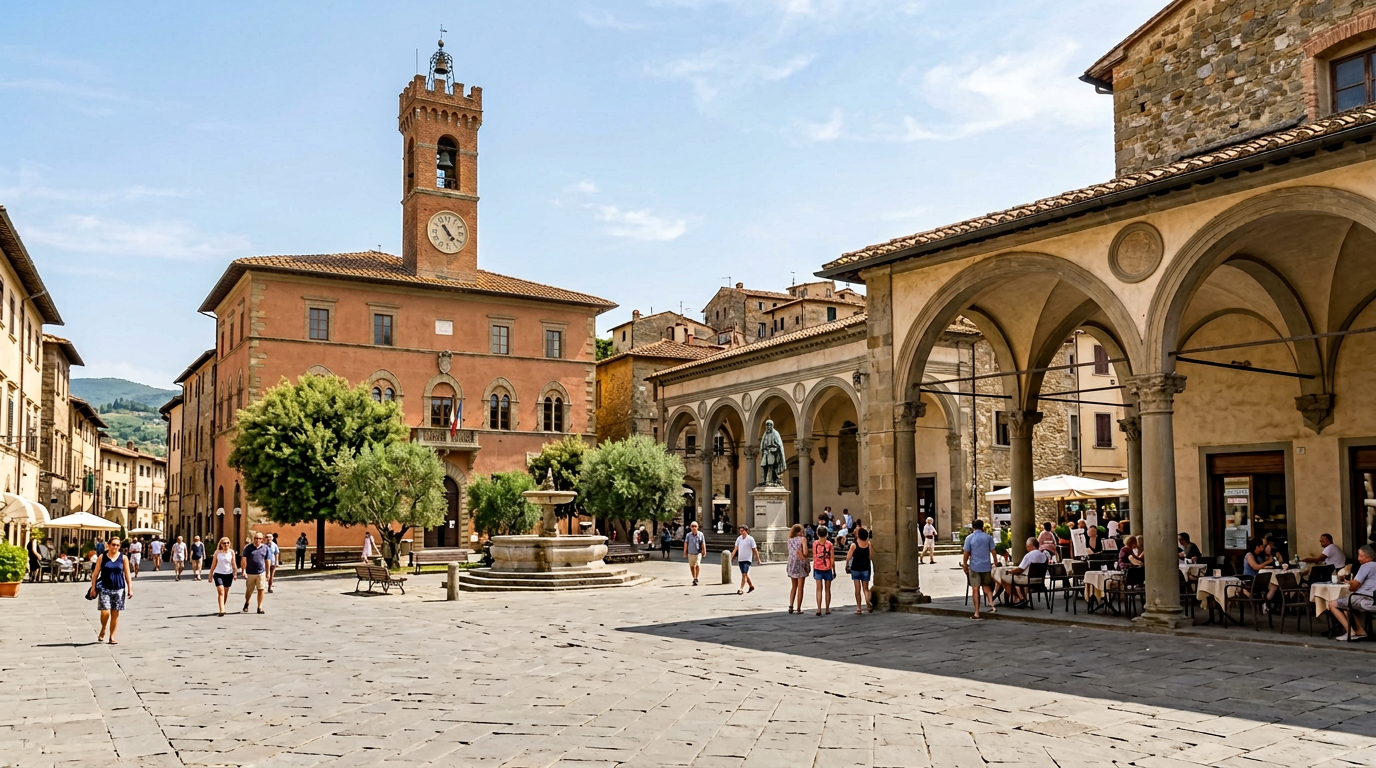
Piazza del Popolo, the central square of Castelfiorentino, is flanked on one side by a nineteenth-century loggia that gives the space its most distinctive visual element. The arched arcade provides shade in summer and a covered walkway in wet weather. The square is used for markets, public events, and the ordinary daily life of the town.
The Collegiata di San Lorenzo occupies one end of the square. The baroque facade dates from a later period than the medieval foundation of the church. The interior is worth a brief visit for the organ, one of the finest historical instruments in the lower Val d’Elsa, and for the paintings from the sixteenth and seventeenth centuries that decorate the walls and altars.
Via Testaferrata, the main commercial street, runs from the square toward the old town gate. It is a functional street with independent shops, bars, and the kind of ordinary retail that reminds you this is a working town rather than a preserved stage set.
For lunch, the trattorias in the streets around the central square are reliable. Prices are modest by Tuscan standards: a full meal with pasta, a main course, and a half-litre of house wine typically costs around 20 to 25 euros per person. The pasta is made fresh each day and the meat-based second courses draw on local butchery traditions.
Churches with fresco cycles
The Church of Santa Verdiana stands just outside the historic centre of Castelfiorentino and is dedicated to the town’s most important local saint. Verdiana was a twelfth-century mystic who, according to the accounts written after her death, spent 34 years in a narrow cell built against a tower, in silent prayer and severe ascetic discipline. She died in 1242 and was canonised in 1320. The church built on the site of her cell was rebuilt in the seventeenth century and decorated with a cycle of frescoes depicting her life. The paintings are baroque in style, colourful and dramatic in their narrative presentation.
The Church of SS Ippolito e Biagio, inside the historic centre, has a medieval crypt beneath the main nave. The crypt retains thirteenth and fourteenth-century fresco fragments depicting scenes from the lives of the church’s patron saints. The condition of the frescoes is variable, but the setting — a low vaulted space with rough stone walls — is genuinely atmospheric.
The original tabernacle of the Madonna della Tosse, from which one of the two sets of Gozzoli frescoes now in the museum was detached, stands on the outskirts of Castelfiorentino. The tabernacle structure is still in its original position. Seeing the empty shrine after spending time with the frescoes in the museum creates an interesting reversal of the normal art historical experience.
How to get there from Barberino Val d’Elsa
The drive from Barberino Val d’Elsa to Castelfiorentino takes approximately 20 minutes. The most direct route follows the SR2 north from Barberino and then the SP3 west toward Castelfiorentino. The road passes through the Val d’Elsa valley floor and is straightforward to drive.
If you are travelling by train, Castelfiorentino is on the Florence-Siena line via Empoli. From Florence, the journey takes about 40 minutes. From Barberino Val d’Elsa station, a direct connection is less convenient than the car, but the train from Florence is a practical alternative if you are combining this with a day in the city.
Parking is available in several free car parks around the historic centre. The most convenient is near the Collegiata on Piazza del Popolo. The museum is a short walk from the square.
Where to stay
Sogno d’Oro guesthouse is set near Barberino Val d’Elsa in the Val d’Elsa countryside. Castelfiorentino is just 18 kilometres away, making it the kind of easy morning excursion that does not require any particular logistical planning. You can leave after breakfast, see the Gozzoli frescoes, have lunch in town, and be back at the guesthouse by mid-afternoon.
The Benozzo Gozzoli museum is one of those small Italian cultural rewards that slow travel makes possible. In a more crowded destination, you might spend 15 minutes in front of a major fresco and move on. Here, with a nearly empty gallery and no pressure of time, the experience of standing in front of those luminous paintings is something that stays with you.