Cycling in the Chianti: routes and white roads from Barberino Val d'Elsa
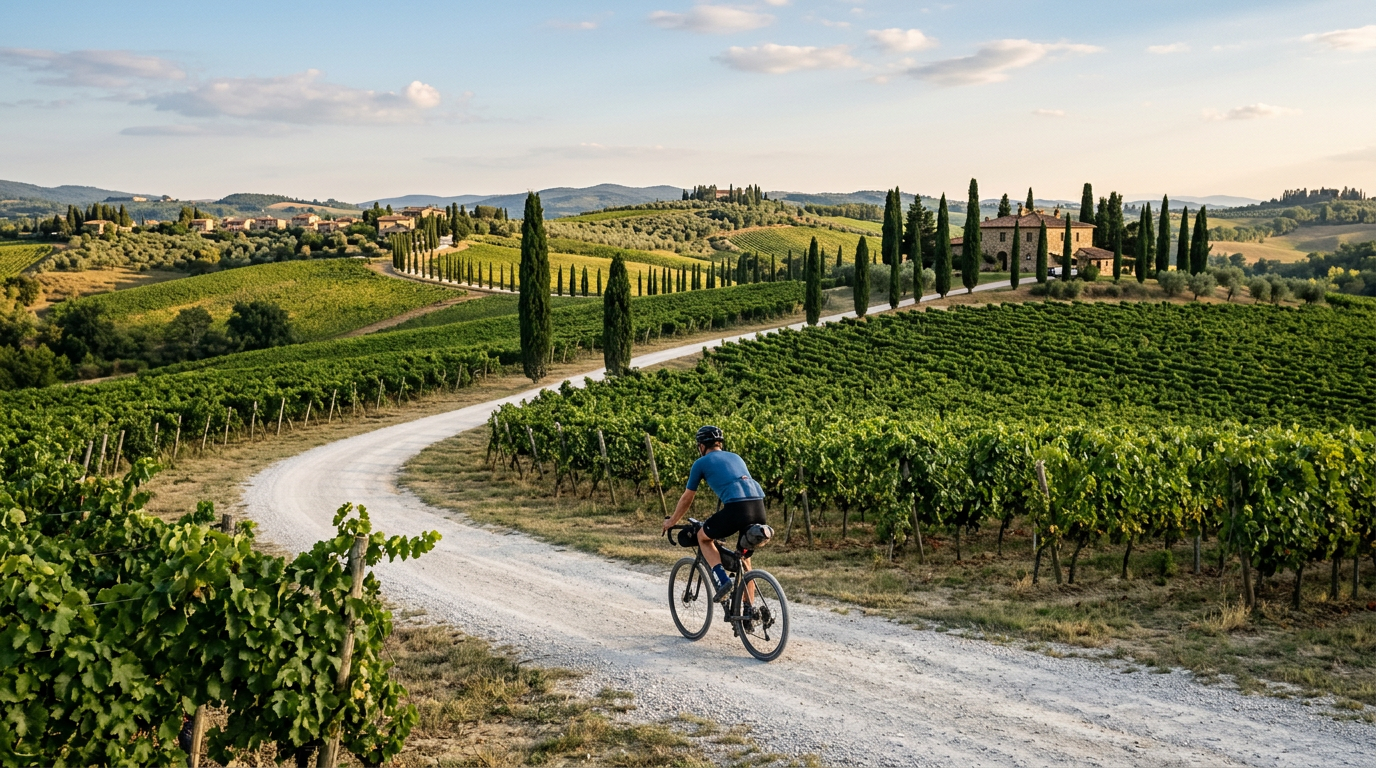
The Chianti is one of the finest cycling landscapes in Italy. Its network of unpaved limestone roads, called strade bianche, threads through vineyard country on gradients that are challenging without being brutal, connecting wine estates, stone villages, and panoramic ridgelines with almost no motor traffic. The Strade Bianche professional race was born from this territory and draws the world’s best cyclists every spring — but the same roads are open and welcoming all year to anyone on two wheels.
From Barberino Val d’Elsa you have immediate access to this network. You do not need to load your bike into a car or drive to a starting point. The white roads begin at the edge of the village, and from there the route options multiply in every direction.
Cycling in the Chianti
Cycling in the Chianti is not primarily about distance or speed. It is about pace, landscape, and the cumulative pleasure of moving through beautiful terrain under your own power. A morning cyclist who covers 40 kilometres on white roads through the vineyards, stops for a coffee at a village bar, and has lunch at an estate before returning has experienced more of this place than most visitors who spend the same time in a car.
The landscape in the Chianti cycling zone divides into two characters. To the east and north, toward Greve and Panzano, the terrain is hillier and the roads gain and lose elevation repeatedly as they cross ridgelines. This is the most photogenic cycling territory, with long views over vine rows and stone farmhouses. To the west and south, toward the Val d’Elsa floor and the areas around Tavarnelle and Poggibonsi, the terrain is gentler and better suited to longer flat distances.
Most cycling routes in the area combine both: use the valley roads to warm up and build pace, then climb into the hills for the vineyard landscape and the views, and descend back to base on the other side.
The best months for cycling in the Chianti are April through June and September through November. Spring offers green vines and wildflowers. Autumn brings the golden colours of harvest and the first cool mornings. Summer is possible but the midday heat on exposed white roads demands an early start and a long rest at midday.
The best routes from Barberino
The circuit toward San Donato in Poggio is the most natural first ride from Barberino Val d’Elsa. The total distance is about 25 kilometres with approximately 350 metres of elevation gain, making it a half-day ride for most cyclists.
From Barberino head south on the valley road toward Tavarnelle Val di Pesa, about eight kilometres of mostly flat riding. Just south of Tavarnelle, turn east on the white road toward Sambuca, a small hamlet surrounded by vine rows. From Sambuca the road climbs steadily toward San Donato in Poggio over about eight kilometres of unpaved white road through the most characteristic vineyard landscape in the area.
San Donato in Poggio sits at the top of a ridge with views east into the Chianti and west toward the Val d’Elsa. The village itself is worth a slow lap: the medieval walls, the small piazza with its central well, and the ancient church of Santa Maria al Prato are all remarkable for a village of this size. The Romanesque church of Sant’Appiano, just a few kilometres back on the road from Barberino, is a detour of under ten minutes and one of the most purely beautiful Romanesque buildings in the Chianti.
A longer route runs north through Certaldo, about 12 kilometres from Barberino, then continues on secondary roads toward Greve in Chianti, another 20 kilometres north. The full out-and-back from Barberino to Greve and back is about 65 kilometres with substantial elevation gain. This is a serious day for a recreational cyclist, but the Greve valley road and the wine town itself at the midpoint make it a highly rewarding one.
A shorter alternative follows white roads southwest from Barberino toward Marcialla and the San Pancrazio area. This route stays under 20 kilometres total, is mostly unpaved, and passes through mixed farmland, olive groves, and light woodland that feels genuinely remote despite being only minutes from the village.
White roads through vineyards
The strade bianche of the Chianti are compacted limestone gravel roads maintained by the local municipalities and the private estates that they cross. They are suitable for gravel bikes, touring bikes, and most hybrid bicycles. Road bikes with tyres narrower than 25 mm will find sections uncomfortable. A gravel bike or cyclocross bike is the most comfortable option but far from obligatory.
After rain, these surfaces become treacherous. The limestone dust turns to slick mud that provides almost no grip. Allow at least 24 hours after significant rainfall before cycling on unpaved sections. During rainy periods the paved valley roads make a satisfying alternative for the day.
In dry summer conditions the white roads generate dust. A light coating settles on everything. Bring sunglasses or clear glasses if you are sensitive to dust particles. The dust is harmless but uncomfortable in the eyes.
On any sections that join paved roads, be conscious of summer tourist traffic. The Chiantigiana, the main road through the heart of the Chianti Classico zone, carries significant vehicle traffic on summer weekends. Where possible use the parallel white road alternatives. On paved sections ride predictably and in single file.
Morning is the best time for cycling in the Chianti, for multiple reasons. The light is better, casting long shadows across the vine rows. The temperatures are cooler. The traffic is lighter. And arriving at a winery or a village viewpoint by ten in the morning gives you the best of the morning before the midday heat builds.
Bike rental in the area
If you have not brought your own bicycle, several rental options exist within reasonable reach of Barberino Val d’Elsa.
Greve in Chianti, about 20 kilometres to the northeast, has established itself as the cycling hub of the Chianti Classico zone. Rental shops there offer road, gravel, and electric-assisted bicycles by the day or half-day. Staff can advise on routes, provide maps, and suggest estates worth visiting along the way.
In Siena, about 35 kilometres south of Barberino, several rental operations provide touring and gravel bicycles with full equipment including helmets, bags, and GPS devices. Electric-assisted bikes are widely available in Siena and dramatically extend the accessible range for cyclists of moderate fitness.
Electric bikes deserve particular mention for the Chianti terrain. The hills that make this landscape beautiful also make it demanding. An e-bike turns a challenging climb into a manageable effort and extends your range by 50 percent or more. Many people who would not consider themselves cyclists find an e-bike in the Chianti one of the best decisions of their trip.
Ask at Sogno d’Oro about current local rental availability. Arrangements change between seasons and local knowledge is more current than any guide.
How to plan a one-day cycling tour
A well-structured one-day cycling tour from Barberino Val d’Elsa can proceed as follows.
Start between seven and seven-thirty. Take the valley road south toward Tavarnelle Val di Pesa, about eight kilometres of flat warm-up riding. At Tavarnelle, turn east on the white road toward Sambuca. Climb the white road from Sambuca to San Donato in Poggio: eight kilometres, about 200 metres of elevation gain.
Arrive at San Donato by nine-thirty. Stop for an espresso at the village bar. Walk the short perimeter of the medieval walls. Continue south from San Donato on the white road descent toward Panzano in Chianti, about ten kilometres of mostly downhill riding through vineyards.
At Panzano, stop at one of the estates for a morning tasting if you have booked ahead. Several producers here welcome visiting cyclists and provide outdoor seating. Lunch in Panzano or continue three kilometres to Greve for a wider choice.
Return from Greve to Barberino on the secondary western valley road, about 22 kilometres of rolling terrain. Total for the day: approximately 60 kilometres with 500 metres of elevation. This is a long day for a recreational cyclist. For a more comfortable version, return directly from Panzano to Barberino and bring the total to about 35 kilometres.
Where to stay
Sogno d’Oro in Barberino Val d’Elsa sits at the natural starting point for the best cycling terrain in the Chianti. You can step out of the guesthouse and be on white roads through vineyards within minutes, without loading a car or navigating to a trailhead.
The guesthouse has secure space for storing bicycles. The surrounding countryside rewards slow travel by bike more than almost any other mode.