Passignano Abbey visit: history, wine, and 15 minutes from Barberino
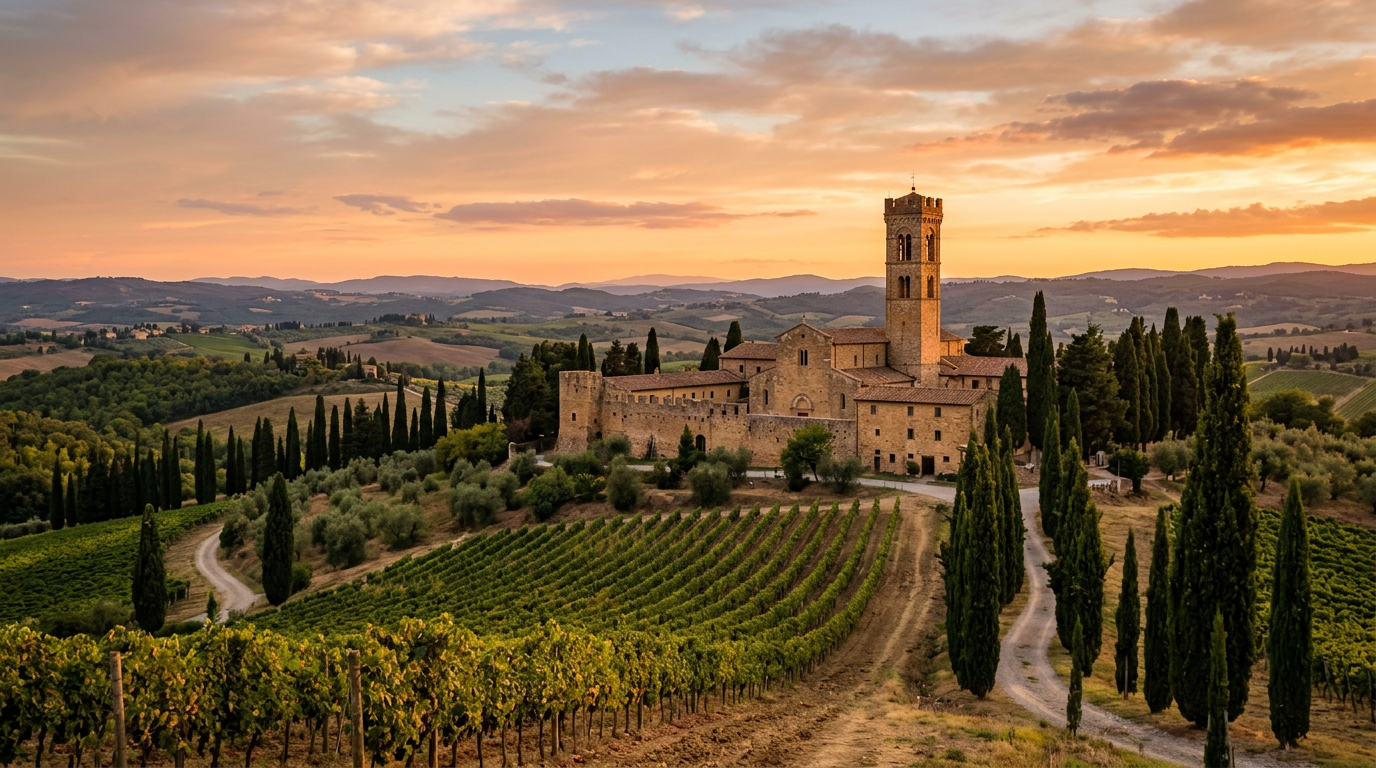
Badia a Passignano is one of the most remarkable places within reach of Barberino Val d’Elsa. It sits on a low hill above the Chianti vineyards, visible from the road that connects Tavarnelle and San Donato in Poggio, its stone buildings and cypress avenue announcing it from a distance with the unhurried authority of a place that has occupied the same ground for nearly a thousand years.
From Barberino Val d’Elsa the distance is only 12 km. The drive takes about 15 minutes. For travellers staying in the area, this is the kind of monument that rewards a half-morning rather than a full day — enough time to absorb the history, walk the complex, and perhaps stop at the estate tasting room before returning.
Passignano Abbey: history
The abbey was founded in 1049 by Giovanni Gualberto, a Florentine nobleman who had already established the Vallombrosan monastic order at its mother house in the Casentino mountains east of Florence. The Vallombrosans follow the Benedictine rule with particular emphasis on communal life, manual labour, and a strict rejection of clerical wealth and privilege. Their order spread across central Italy during the 11th and 12th centuries and Passignano became one of its most important foundations.
Over the following centuries the abbey accumulated a large landholding in the Chianti through gifts, purchases, and inheritance. The vineyards and olive groves you see surrounding the abbey today are a direct continuation of this medieval agricultural estate — not a recreation or a later addition, but the same land managed by the same community, at least in its essential form.
The complex was enlarged and rebuilt in the 12th, 14th, and 15th centuries. The defensive towers and thick walls give it the silhouette of a fortified village from a distance. This appearance was not purely symbolic: the Chianti hills were contested territory for centuries, and religious communities needed to defend their property as much as any secular lord.
Inside the church of San Michele Arcangelo there is a Last Supper painted by Domenico Ghirlandaio in the late 15th century. Ghirlandaio also trained Michelangelo, and his Passignano fresco — one of several Last Suppers he painted — shows the Florentine Renaissance at a moment of extraordinary confidence in representation and visual storytelling. Access to the refectory is possible on certain guided visits.
The Marchesi Antinori connection to Passignano dates from the 15th century. One of the most prominent wine families in Chianti Classico, the Antinoris have maintained a close relationship with the abbey estate for over 600 years. The Badia a Passignano Chianti Classico Gran Selezione — produced from the vineyards that surround the walls — is among the most respected wines in the entire denomination.
What you see during the visit
Guided visits to the abbey are available on certain days of the week. The tour covers the church, the cloister, the refectory, and sections of the conventual buildings. The structure of the visit is shaped by the fact that this remains an active monastic community: some areas are not open to visitors, and the atmosphere throughout is that of a place where daily religious life continues independently of the tourism.
The church is the first stop and the most important. The space is Romanesque in its bones, altered and enriched over the subsequent centuries, but retaining a quality of stone-built gravity that the later accretions have not disrupted. The Ghirlandaio fresco is in the refectory, which is sometimes accessible during the tour.
The cloister is an enclosed courtyard with a 15th-century arcade. It is the quietest part of the complex and the one that best communicates the contemplative function of the building. The proportions are modest rather than grand, which makes the space feel genuinely inhabited rather than designed for effect.
The surrounding landscape is itself part of the visit. The cypress avenue approaching the abbey has been there for centuries. The vineyard rows below the walls belong to the Antinori estate. Looking back from the abbey entrance toward the western Chianti hills gives you one of the most characteristic views in the entire denomination — vineyards, oak woodland, distant ridges, and the specific quality of Tuscan afternoon light.
The farm and the wine
The Marchesi Antinori estate at Passignano produces several wines from the surrounding vineyards. The flagship is the Badia a Passignano Chianti Classico Gran Selezione, a single-vineyard wine that expresses the specific characteristics of this hillside site with consistency and depth. It is aged in large Slavonian oak barrels, which preserve the freshness of the fruit while allowing the tannins to evolve over time. This is a wine designed for ageing.
The standard Chianti Classico from the estate is more immediately approachable. It offers a reliable entry into the Passignano terroir at a more accessible price.
The enoteca and tasting room at the estate are open for booked visits. A cellar tour and guided tasting of three or four wines costs between 25 and 60 euros per person depending on the wines selected. The higher-priced tastings include older vintages of the Gran Selezione.
For a more informal purchase without a full tasting, wines can be bought directly from the estate shop. This requires no appointment. The same wines are available at a fraction of what you would pay in a restaurant.
Combining an abbey visit in the morning with a wine tasting at the estate in the early afternoon makes an ideal short excursion from Barberino Val d’Elsa — focused, unhurried, and deeply rooted in what makes this particular part of the Chianti landscape distinctive.
How to book the visit
Abbey visits are guided and must be booked in advance. The schedule of open days varies by season and is not always predictable. Contact the abbey directly through the Vallombrosan order website or by telephone. The secretariat manages booking and can confirm available days and times. Tours are typically conducted in Italian, though English-speaking guides are sometimes available with advance notice.
Group sizes for tours are limited to 15 to 20 people. Private visits for smaller groups can sometimes be arranged with advance notice and a donation contribution.
For the Antinori estate tasting, booking is done through the Marchesi Antinori website. The booking process is straightforward. Respond to any confirmation requests promptly, as slots at this estate fill quickly in the main season.
If you want to combine the abbey tour and the wine tasting on the same visit, ask both parties when booking. Combined arrangements are sometimes available and avoid the need to coordinate two separate bookings independently.
How to get there from Barberino Val d’Elsa
From Barberino Val d’Elsa take the road toward Tavarnelle Val di Pesa, 8 km to the east. From Tavarnelle continue east toward Badia a Passignano. The abbey is visible from the approach road and well signposted in the final kilometres.
Total distance: approximately 12 km. Drive time: about 15 minutes.
Parking is available in an unpaved lot near the abbey entrance. The site is not accessible by regular public transport. A car or bicycle is needed. The road from Barberino to Passignano is pleasant for cycling — about 25 km in total for the round trip — and passes through classic Chianti Classico landscape on quiet secondary roads.
Where to stay
Sogno d’Oro in Barberino Val d’Elsa is 15 minutes from Badia a Passignano. Very few places to stay in the Chianti put you this close to a monument of this historical and cultural weight. If you want to understand the long relationship between monastic life, agricultural management, and wine production that defines this landscape, Passignano is where that understanding becomes concrete.